
Views: 0 Author: Site Editor Publish Time: 2026-11-02 Origin: Site


Engineers frequently face a tough metallurgical dilemma. 4140 chromium-molybdenum steel provides exceptional tensile strength and impact toughness. However, its high carbon content makes it notoriously difficult to weld without compromising structural integrity. We know you need highly durable components. You also need reliable, defect-free welded joints. Should you specify 4140 for applications demanding both high strength and fabrication flexibility? The answer requires careful evaluation.
While welding this robust alloy is entirely feasible, you must implement rigid thermal controls. Ignoring these mandatory protocols invites catastrophic failure in the field. This comprehensive guide covers the fabrication realities you must understand. We will explore specific welding procedures, hidden fabrication costs, and vital material verification steps. You will learn exactly what to evaluate before greenlighting a project using a 4140 forged steel bar.
4140 steel has a high Carbon Equivalent (CE), making it highly susceptible to brittle heat-affected zones (HAZ) and cracking if thermal controls are ignored.
Strict welding preheat and interpass temperature maintenance are non-negotiable to slow the cooling rate and prevent martensite formation.
Post weld heat treatment (PWHT) is required to relieve residual stresses and restore ductility.
Utilizing a low-hydrogen welding process and matching filler metals is critical to preventing delayed hydrogen cracking.
Before sourcing a forged steel bar, buyers must review Mill Test Reports (MTRs) to verify exact chemistry, as minor carbon fluctuations dictate the required thermal parameters.
Evaluating 4140 weldability requires a deep look at its underlying chemistry. The primary metallurgical challenge stems from its Carbon Equivalent (CE). The CE value for 4140 typically sits above 0.60. In metallurgical terms, a high CE indicates high hardenability. When you expose this material to the rapid heating and cooling cycles of an electric arc, the microstructure changes drastically. The austenite phase cools too quickly. It transforms into untempered martensite. This creates an extremely brittle Heat-Affected Zone (HAZ).
Because of this transformation, we cannot classify 4140 as easily weldable. Instead, you should frame the material as weldable under strict conditions. Fabricators must respect the chemistry. They must manipulate the cooling curve to prevent brittle microstructures from forming.
Decision-makers must apply a strict evaluation lens before choosing this alloy. You should ask a fundamental question. Does the component's operational stress truly necessitate the high yield strength of 4140? The intense fabrication controls required for this steel will inflate project budgets. If the application only requires moderate strength, the welding risks might outweigh the material benefits. You must balance the mechanical advantages against the fabrication complexities.
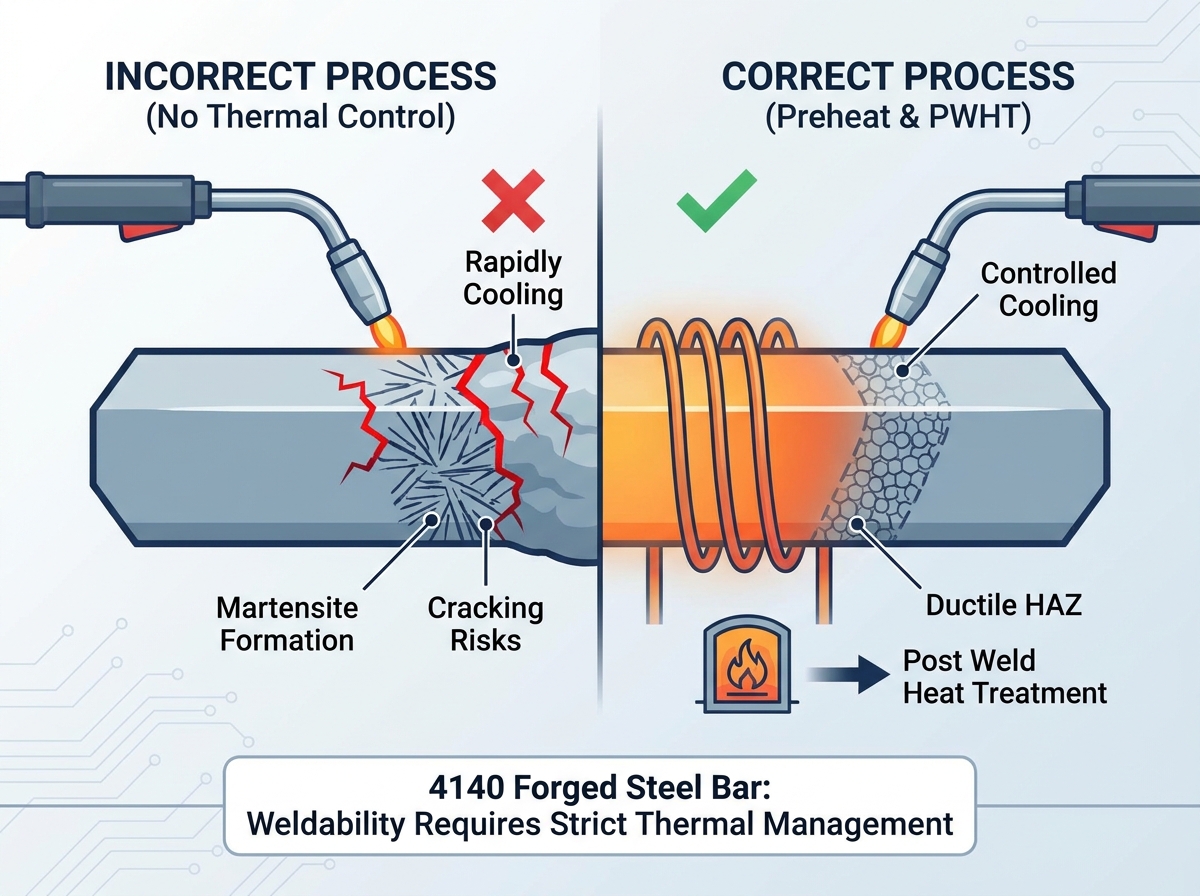
You cannot strike an arc on cold 4140 steel. Applying a strict welding preheat is an absolute necessity. Fabricators must bring the base material to a specific temperature range prior to welding. This range typically falls between 400°F and 600°F (200°C to 315°C). The exact target depends on the material thickness and the specific carbon content of the heat lot.
Preheating serves a critical metallurgical function. It significantly slows the cooling rate of the weld puddle and the surrounding HAZ. A slower cooling rate prevents the formation of brittle martensite. Furthermore, elevated temperatures allow trapped hydrogen to diffuse out of the weld metal. If the metal cools too fast, hydrogen becomes trapped inside the crystalline lattice. This trapped gas creates immense internal pressure, eventually leading to catastrophic cracking.
Selecting the right filler metal is just as important as thermal control. You must utilize low-hydrogen consumables. Common choices include E7018 or E8018 stick electrodes. For wire-fed processes, ER80S-D2 is a frequent choice. These filler metals match the base material's strength requirements while minimizing hydrogen introduction.
Buying low-hydrogen electrodes is only the first step. You must also store them correctly. Fabricators must keep these electrodes in dedicated baking ovens. Exposure to ambient humidity ruins low-hydrogen consumables. The flux coating absorbs moisture from the air. During welding, the arc breaks this moisture down into hydrogen and oxygen. The hydrogen then enters the weld pool, setting the stage for severe joint failure.
The thermal management process does not end when the welding stops. You must implement a dedicated post weld heat treatment cycle. After completing the joint, the component must cool slowly. Fabricators often wrap the assembly in thermal blankets to control this descent. Once it reaches a safe handling temperature, the component must immediately transition into a stress-relief or full tempering furnace.
PWHT typically occurs around 1100°F to 1250°F (590°C to 675°C). This sustained heat relieves residual stresses built up during the welding process. It also tempers any hard zones, restoring ductility to the assembly. Skipping this final heat treatment almost guarantees eventual catastrophic failure. Dynamic loads will quickly exploit the brittle, highly stressed HAZ, tearing the component apart.
Even experienced fabricators encounter issues when working with high-carbon alloys. Understanding common failure modes helps you implement better quality control measures.
The most insidious threat to 4140 assemblies is delayed cracking. Trapped hydrogen causes under-bead cracking hours or even days after the weld has cooled. A joint might pass an initial visual inspection perfectly. Later, sitting on a shelf or during early operation, the internal pressure fractures the steel. You must prevent hydrogen cracking at all costs. It represents a severe risk for liability and quality control. Strict adherence to preheating and low-hydrogen practices remains your best defense.
Heavy-section components are highly susceptible to thermal shock. Uneven heating warps the steel. Rapid ambient cooling creates massive internal stresses. If a fabricator applies intense heat to one side of a thick shaft without warming the entire circumference, the metal will distort. You must ensure uniform heat distribution during both preheating and post-weld cooling.
Preventing these failures requires rigorous documentation and procedural discipline. We recommend following these specific mitigation steps:
Draft a comprehensive WPS: Develop a Welding Procedure Specification (WPS) tailored specifically to 4140 steel.
Qualify the procedure: Create a Procedure Qualification Record (PQR) specific to the heat lot of your material.
Monitor temperatures constantly: Use calibrated thermocouples or temperature-indicating crayons to verify interpass temperatures.
Control the cooling environment: Never allow a welded 4140 component to cool in a drafty or damp environment.
Engineering decisions always involve financial realities. You must evaluate the true fabrication economics before specifying this alloy.
The base raw material cost of 4140 is relatively standard. However, the processing requirements significantly increase overall fabrication costs. You must account for the specialized equipment needed. Fabricators require preheat rigs, controlled cooling blankets, and large PWHT furnaces. Furthermore, the process demands highly skilled, specialized labor. Welders must monitor interpass temperatures meticulously. These mandatory steps consume time and resources, driving up the final project budget.
Despite the high fabrication costs, 4140 remains the perfect choice for specific high-stress applications. You should specify it when wear resistance and torsional strength are paramount. Oil and gas downhole tools rely heavily on this alloy. Heavy equipment shafts and high-impact gears also benefit from its exceptional toughness. In these scenarios, the performance benefits easily justify the rigorous fabrication expenses.
Sometimes, the operational stress does not justify the fabrication headache. In these cases, buyers should pivot to lower-carbon alloys. 4130 steel serves as an excellent alternative. It offers significantly better weldability due to its lower carbon content. You will experience a slight trade-off in maximum hardenability. However, you will save considerably on fabrication costs without sacrificing necessary performance.
Alloy Comparison: 4140 vs. 4130 Steel Weldability
Property |
4140 Steel |
4130 Steel |
|---|---|---|
Carbon Content |
0.38% - 0.43% |
0.28% - 0.33% |
Weldability |
Difficult (Requires strict controls) |
Moderate (Easier to control) |
Preheat Requirement |
High (400°F - 600°F) |
Moderate (300°F - 400°F) |
Hardenability |
Very High |
High |
Fabrication Cost |
High (Extensive thermal management) |
Moderate (Fewer thermal restrictions) |
Successful fabrication begins long before the welder strikes an arc. Material verification is your first line of defense against joint failure.
Before you buy a forged steel bar, you must review the Mill Test Reports (MTRs). Instruct your procurement team to check the exact chemical composition. The carbon content dictates your thermal parameters. A carbon content on the high end of the allowable range (e.g., 0.43%) requires much stricter preheating than one on the lower end (0.38%). You cannot guess these values. You must verify them.
Welding magnifies existing material defects. The intense heat will expose any internal flaws. Therefore, you must emphasize internal soundness during procurement. Specify ultrasonically tested (UT) forged bars. UT inspection ensures there are no internal voids, cracks, or non-metallic inclusions. A hidden inclusion near the weld zone will almost certainly cause the joint to fail under load.
Your supply chain matters. We recommend sourcing from suppliers who understand metallurgical requirements. Look for partners who can provide material in the annealed condition. Annealed 4140 is significantly easier to machine and fabricate. Additionally, demand full heat lot traceability. If a weld fails, you need the ability to trace the material back to its exact origin to determine the root cause.
4140 is an exceptional steel grade capable of handling extreme mechanical stress. However, integrating it into welded assemblies requires a committed investment in thermal control and quality assurance. You cannot cut corners. Preheating, low-hydrogen practices, and post-weld heat treatments are mandatory steps for success.
We advise decision-makers to align their engineering requirements with their fabricator’s capabilities. Do this before issuing any purchase orders. Ensure your shop floor has the equipment and discipline necessary to handle high-carbon alloys safely.
If you are planning a critical project, do not leave material quality to chance. Encourage your engineering team to consult with metallurgy experts. Request a quote for certified, MTR-backed forged steel bars tailored to your specific manufacturing tolerances. Proper sourcing and strict fabrication protocols will ensure your assemblies perform flawlessly in the field.
A: Yes, you can weld 4140 to mild steel using dissimilar metal techniques. You must preheat the joint based on the 4140 material requirements. Fabricators typically utilize a filler metal accommodating dilution from both base metals, such as a 309L stainless or a specialized low-alloy filler. Afterward, apply appropriate stress relief to prevent cracking.
A: Skipping preheat leads to rapid cooling of the weld pool. This causes the Heat-Affected Zone (HAZ) to form untempered, brittle martensite. As a result, you risk immediate or delayed cracking under minimal stress. Proper preheating is absolutely non-negotiable for maintaining joint integrity.
A: Both processes work well. TIG (GTAW) is often preferred for precision joints. It offers better control over heat input and hydrogen exclusion. MIG (GMAW) is more efficient for heavy deposition on large forged components. You must ensure you use low-hydrogen wire and the correct shielding gas for MIG applications.
A: Yes. Welding destroys the existing heat treatment in the HAZ. It creates a soft band alongside a highly brittle zone. Pre-hardened 4140 usually requires a full re-heat-treatment, involving quenching and tempering, after welding. This restores uniform mechanical properties across the entire assembly.


