
Views: 0 Author: Site Editor Publish Time: 2026-11-08 Origin: Site


Upgrading materials for high-stress components forces a strict evaluation. You must weigh mechanical limits against production budgets. Every material choice directly impacts operational performance and field reliability. Both 4140 and 4340 are highly capable high-tensile alloys. However, over-specifying wastes your budget on expensive raw materials and extended machining time. Conversely, under-specifying risks catastrophic component failure during operation.
We aim to provide engineering and procurement teams with a clear, technical comparison. You will explore chemical compositions, structural benefits, and core performance metrics. This guide helps you evaluate physical limits against manufacturing realities. Ultimately, this ensures you determine the correct forged steel bar for critical applications.
A forged steel bar inherently offers superior directional grain flow and impact resistance compared to cast or rolled alternatives, regardless of the specific alloy.
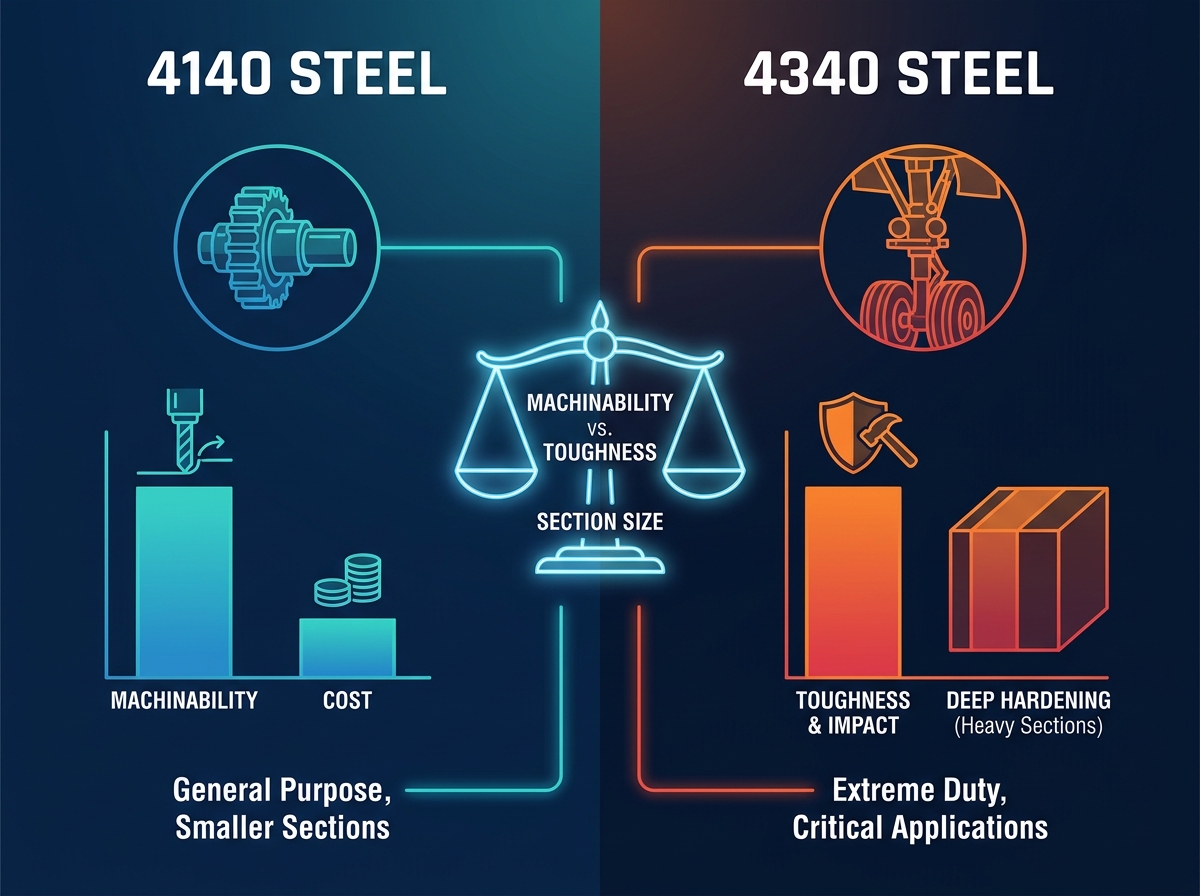
4140 machinability and lower raw material costs make it the pragmatic choice for general-purpose, high-stress components with smaller cross-sections.
4340 toughness, driven by its nickel content, makes it mandatory for heavy-section components facing extreme fatigue, severe impact, and sub-zero temperatures.
The final decision hinges on total cost of ownership: material price, machining time, heat treatment requirements, and required component lifespan.
Defining the exact failure risks of the component remains your first priority. Parts fail for different reasons in the field. Some suffer from cyclic fatigue over millions of operational cycles. Others experience sudden, massive shear forces. High-velocity impacts can cause brittle shatter in substandard materials. Abrasive wear slowly degrades surface integrity over time. You must identify the dominant failure mode before selecting an alloy. A transmission gear tooth faces entirely different stresses than a heavy oilfield drilling collar. Analyzing these specific operational loads clarifies your true material baseline.
You need to balance required yield strength and hardenability effectively. Stronger materials often cost significantly more to machine and process. You must maintain acceptable tooling costs throughout the production run. Lead times also dictate crucial procurement decisions. Specifying an exotic aerospace grade might unnecessarily delay production. Engineers must weigh physical limits against manufacturing realities. A successful specification meets all safety margins while preserving profit margins. It requires close collaboration between design engineers and manufacturing teams.
Why should you specify a forged product over billet or cast stock? The forging process provides unparalleled structural integrity. Mechanical compression during forging physically destroys internal voids. It eliminates the micro-shrinkage often found in cast components. Furthermore, forging creates a highly aligned grain structure. The internal grain flow follows the exact contour of the finished part. This directional strength resists crack propagation far better than unidirectional billet stock.
Void Elimination: Mechanical compression destroys internal casting porosity and prevents premature cracking.
Grain Alignment: Internal structures mirror the external geometry, delivering peak directional strength exactly where operational forces hit hardest.
Defect Reduction: Surface inclusions are minimized compared to raw cast ingots, reducing the risk of fatigue initiation.
This structural refinement makes the forged baseline mandatory for mission-critical applications. Both 4140 and 4340 benefit immensely from this process.
Understanding the chemical makeup forms the engine behind any reliable alloy steel comparison. 4140 relies heavily on chromium and molybdenum. Chromium acts as a potent carbide former. It increases hardenability significantly during heat treatment. These stable carbides resist wear and abrasion effectively. Molybdenum works alongside chromium to push transformation curves efficiently. It improves high-temperature stability and mitigates temper embrittlement. This combination provides excellent wear resistance. It creates a robust, dependable matrix for general industrial use.
4340 introduces a crucial chemical addition. It contains approximately 1.8% nickel. This single element fundamentally alters the entire steel matrix. Nickel significantly increases the overall toughness of the alloy. It lowers the ductile-to-brittle transition temperature dramatically. This prevents catastrophic brittle failure under severe shock loading. Furthermore, nickel enables deep through-hardening in massive sections. It ensures uniform mechanical properties across large diameters. While 4140 relies purely on chromium and molybdenum, 4340 leverages nickel to survive extreme environments.
Always acknowledge material assumptions before finalizing your specification. Minor variations in mill chemistry limits affect baseline properties. These slight variations exist even within strict ASTM standard ranges. A poorly processed heat of 4340 might underperform compared to a premium heat of 4140. Sourcing matters greatly. Procurement teams must verify mill certifications rigorously. This guarantees the raw material meets expected performance thresholds before costly machining begins.
Strength and deep hardening differentiate these two alloys immediately. 4140 offers excellent surface-to-core hardness in many applications. However, this applies mainly to smaller cross-sections. You typically see optimal results in diameters under four inches. Beyond this size, 4140 suffers a noticeable core strength drop-off. The quenching process simply cannot penetrate deeply enough. 4340 solves this exact physical limitation. It maintains uniform hardness and strength in heavy sections. It achieves consistent mechanical properties in diameters up to eight inches or more.
Engineers often evaluate fatigue and impact resistance as overall toughness. This is exactly where 4340 toughness dominates the engineering field. The nickel-enriched matrix absorbs immense kinetic energy before fracturing. It excels in high-impact, cyclic-stress environments. Common applications include commercial aircraft landing gear and aggressive oilfield drilling equipment. These environments demand absolute reliability against unpredictable shock loads. Microscopic voids act as stress concentrators, but the forged 4340 matrix resists crack propagation fiercely.
Machinability directly drives daily manufacturing budgets. 4140 machinability is generally rated at roughly 65% of standard carbon steel. It yields highly predictable chip formation. Operators experience manageable tool wear during prolonged runs. You can run standard carbide inserts efficiently. 4340 presents a much tougher manufacturing challenge. It sits at a lower 50% machinability rating. The tough nickel matrix resists cutting forces aggressively. The continuous, ductile chips generate immense heat at the cutting edge. You must employ slower feeds, reduced speeds, and high-pressure coolant. You also need specialized high-performance tooling. This significantly increases cycle times and overall production costs.
Feature / Metric |
4140 Steel |
4340 Steel |
|---|---|---|
Primary Alloying Elements |
Chromium, Molybdenum |
Nickel, Chromium, Molybdenum |
Deep Hardening Capacity |
Optimal under 4 inches |
Effective up to 8+ inches |
Machinability Rating |
~65% |
~50% |
Shock & Impact Resistance |
Moderate to High |
Extreme (Aerospace/Oilfield level) |
Raw Material Cost Profile |
Lower Baseline |
Higher Premium |
Evaluating quench cracking risks requires careful metallurgical attention. Heat treatment is a highly critical phase for both alloys. 4340 is significantly air-hardenable. It requires strict thermal control during and after the forging process. Rapid cooling induces severe internal stresses. This frequently leads to quench cracking if mismanaged. You must closely control quenching mediums and tempering temperatures. 4140 remains slightly more forgiving during the quench cycle. However, both require skilled handlers to achieve peak mechanical properties without inducing invisible micro-cracks.
Weldability constraints pose another serious manufacturing challenge. Neither alloy is inherently welder-friendly. Their high carbon and alloy contents promote brittle martensite formation during cooling. You must employ significant pre-heating before striking an arc. Elevating the core temperature prevents the rapid cooling of the weld pool. Post-weld stress relief is equally mandatory. Failing to hold the component at an elevated temperature guarantees weld-zone cracking. 4340 is notably more sensitive to these intense thermal shocks.
Industry standards dictate strict compliance protocols. You must match the alloy to exact regulatory specifications. ASTM A29 outlines the general chemical requirements for standard industrial applications. Aerospace material specifications (AMS) demand far stricter limits. They tightly control trace impurities like sulfur and phosphorus. These microscopic inclusions act as initiation sites for fatigue cracks. API standards govern components used exclusively in the oil and gas sector. They dictate specific impact testing requirements at sub-zero temperatures. Adhering to these frameworks ensures reliable field performance.
Shortlisting the correct material requires a highly structured approach. Use these specific criteria to guide your final engineering choice.
Material budgets and machining costs represent primary project constraints.
Part cross-sections are moderate to small (typically under four inches thick).
The application requires high tensile strength for continuous operation.
The component does not face extreme, unpredictable shock loads. Common examples include standard gears, automotive axles, and industrial drive shafts.
The cost of component failure drastically outweighs raw material and machining expenses.
The part features a large, heavy cross-section requiring uniform through-hardness.
The operating environment involves extreme cyclic fatigue over millions of cycles.
The component operates in extreme cold conditions. Common examples include aerospace landing gear, heavy mining shafts, and deep-hole drilling collars.
Both 4140 and 4340 deliver exceptional mechanical capabilities for demanding industries. 4140 provides the best strength ratio for standard high-stress applications. It keeps tooling budgets manageable and machines predictably. Conversely, 4340 represents an uncompromising, heavy-duty solution. It thrives in extreme environments and massive heavy sections where other alloys fail.
We recommend consulting an experienced metallurgist before finalizing your design. Engage your forging supplier early in the engineering phase. Review your exact blueprints together. Assess local heat-treating capabilities and verify supply chain availability. Completing these steps ensures you specify the right material for flawless field operation.
A: You can substitute 4140 only if the part does not require deep hardening in thick sections. The application must also avoid severe impact forces or aerospace-level fatigue standards. 4140 provides adequate strength for standard gears and shafts. However, replacing 4340 in massive, high-shock components invites catastrophic failure.
A: Forging aligns the internal grain flow to match the exact contour of the finished part. This structural alignment multiplies the inherent toughness of the nickel-alloy matrix. It creates superior resistance against shear forces. The mechanical compression also eliminates internal voids, preventing premature fatigue cracking under heavy loads.
A: 4140 is generally more forgiving during the quench and temper process. It presents a lower risk of quench cracking. Conversely, 4340 is highly air-hardenable. It requires precise atmospheric and temperature controls. You must manage cooling rates strictly to avoid severe internal stress cracking during the heat treatment cycle.


