
Please Choose Your Language


close
Choose Your Site
Global
Social Media
Views: 0 Author: Site Editor Publish Time: 2026-10-29 Origin: Site


Operating in high-stress industrial environments like aerospace, oil and gas, or heavy machinery requires uncompromising material standards. Engineers constantly face a highly specific challenge when designing large-scale, load-bearing components. You must maintain critical mechanical properties deep within the core of the part.
Unfortunately, many standard alloys suffer from rapid cooling drop-offs during the heat treatment process. This thermal reality leaves heavy sections vulnerable. It frequently results in components containing brittle exteriors or dangerously soft cores. Experiencing a component failure at this massive scale inevitably leads to catastrophic downtime and severe safety risks for your team.
To combat this, 4340 alloy steel provides a definitive engineering solution for demanding heavy-duty applications. It delivers a unique combination of deep hardenability, fatigue resistance, and structural integrity. We will provide you an evidence-based framework to evaluate, specify, and properly source these materials for your next mission-critical project.
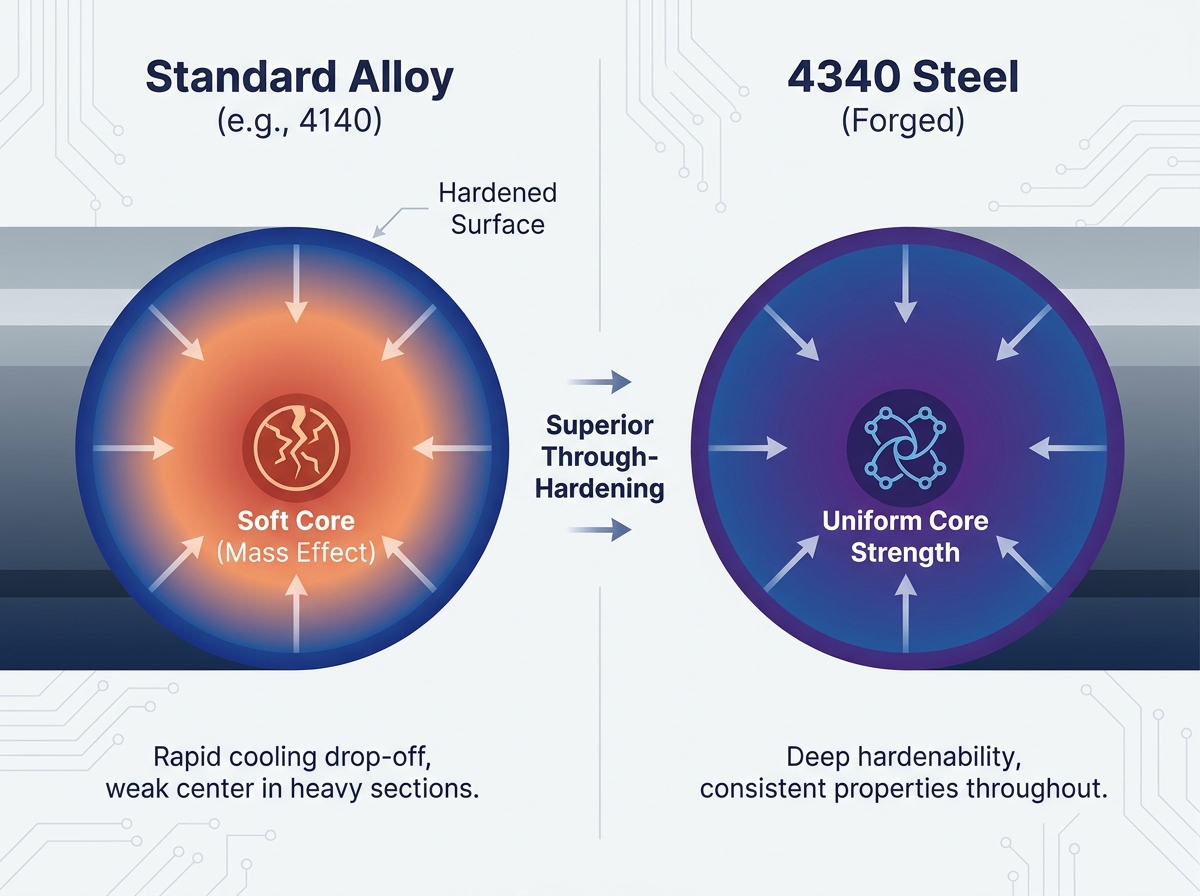
Superior Core Strength: 4340 steel achieves deep through hardening in large cross-sections where standard alloys like 4140 experience severe core strength drop-offs.
Forged Advantage: Utilizing a forged steel bar aligns the internal grain flow with the component’s operational stress profile, maximizing impact toughness and fatigue life.
Cost-Benefit Reality: While 4340 carries a higher upfront material and machining cost, it prevents premature failure and reduces lifecycle costs in mission-critical applications.
Processing Risks: Successful implementation requires rigorous control over heat treatment (quenching and tempering) to prevent cracking and manage machinability.
As your component sizes increase, the underlying physics of material processing shift dramatically. Think about massive power transmission shafts in wind turbines or heavy-duty pump blocks on offshore rigs. The immense mass of the steel fundamentally alters how heat transfers during the hardening process. Metallurgists call this predictable thermodynamic behavior the mass effect.
When you quench lower-alloy steels, the exterior surface cools rapidly. However, the internal core cools far too slowly. The thermal gradient between the surface and the center becomes extreme. This temperature disparity creates a problematic dual-state material. The rapid surface cooling forms a hard martensitic structure. Meanwhile, the delayed core cooling allows softer microstructures like pearlite or bainite to form. You end up possessing a hardened outer shell but a dangerously soft, vulnerable center.
To prevent catastrophic component failures, we must define clear success criteria for these massive sections. A viable industrial material must offer completely uniform yield strength from the surface all the way to the core. It must also maintain exceptional fracture resistance throughout the entire cross-section. Crucially, a large diameter steel bar needs to achieve these robust properties without requiring excessively aggressive quenching methods. Plunging massive, low-alloy parts into aggressive water quenches introduces severe residual stresses. This practice drastically increases the risk of part distortion or internal cracking.
The chemical composition of 4340 sets it apart from standard carbon steels. It relies on a highly engineered, specific blend of alloying elements. This exact chemical mix fundamentally alters the cooling curve of the steel. It pushes the transformation curves to the right on a Time-Temperature-Transformation (TTT) diagram. This delay prevents the formation of weak microstructures during the quenching phase.
Nickel (1.65% - 2.00%): Nickel lowers the ductile-to-brittle transition temperature. It provides extraordinary toughness, especially in freezing operational environments.
Chromium (0.70% - 0.90%): Chromium significantly improves overall hardenability. It also enhances the material's baseline resistance to abrasion and wear.
Molybdenum (0.20% - 0.30%): Molybdenum prevents temper embrittlement. It ensures the steel maintains its strength during high-temperature tempering cycles.
This synergistic blend enables excellent through hardening. Because of its tailored cooling curve, 4340 remains the undisputed industry standard for thick-section parts. It retains a strong martensitic structure far deeper into the material core. You receive uniform mechanical strength regardless of the component's overall thickness. Standard Jominy end-quench tests consistently prove its superiority in retaining hardness at deeper depths compared to simpler alloys.
Next, we must consider the alloy's resilience under dynamic stress. The generous addition of Nickel provides extraordinary impact toughness. This holds true even under severe cyclic loading conditions. Engineers regularly specify it for aircraft landing gear assemblies and rigorous rotary drilling tools for this exact reason. It handles sudden shock loads without propagating micro-cracks.
Finally, the manufacturing method matters immensely. Merely casting or hot rolling 4340 leaves distinct structural vulnerabilities behind. Castings often suffer from internal porosity and dendritic segregation. By contrast, the forging process acts as a massive performance multiplier. Using a properly processed forged steel bar physically eliminates internal voids. The heavy mechanical pressure establishes a continuous, directional grain flow. This grain flow naturally aligns along your anticipated operational stress profile, compounding the inherent fatigue resistance of the alloy.
Making the right material choice requires a strict decision framework. We want to prevent costly over-engineering while completely avoiding dangerous under-specifying. Let us compare 4340 against common industry alternatives to guide your procurement strategy.
First, evaluate 4340 against standard 4140 steel. You should typically specify 4140 for smaller diameters. It works perfectly well for sections under four inches thick. It suits general-purpose shafts, automotive axles, and projects restricted by tighter budgets. However, you must upgrade to a 4340 forged bar for any heavy-section component requiring high yield strength precisely at the core. You also strictly need 4340 for massive parts subjected to extreme torsional forces or repeated shock loads.
Next, consider 4340 versus 300M, which engineers often label as 4340M. 300M is essentially a modified version of 4340. It includes added silicon and vanadium for even higher strength metrics. The silicon prevents temper embrittlement at higher tempering temperatures. This allows 300M to achieve ultra-high ultimate tensile strengths exceeding 280 ksi. However, 300M comes with a severe cost premium. It also suffers from significantly reduced global availability. For most heavy industrial applications outside of specialized aerospace components, standard 4340 remains the optimally balanced workhorse.
Finally, let us discuss scalability and return on investment. We must acknowledge the premium upfront price of 4340 alloy steel. You should frame this investment entirely around risk mitigation. The extra cost of upgrading the raw material is mathematically negligible compared to the alternative. You face immense liability, safety hazards, and millions in downtime costs if a critical turbine shaft suddenly shears in the field.
Material Comparison Chart: 4140 vs. 4340 vs. 300M
Alloy Grade | Primary Alloying Advantage | Ideal Cross-Section Thickness | Best Use Case | Relative Cost |
|---|---|---|---|---|
4140 | Chromium-Molybdenum blend | Under 4 inches | General-purpose shafts, gears | Low |
4340 | Addition of Nickel (Ni) | 4 to 8+ inches | Heavy machinery, oilfield tools | Moderate |
300M | Added Silicon (Si) & Vanadium (V) | Variable (High-stress specific) | Aerospace landing gear, race axles | High |
We must outline transparent assumptions regarding manufacturing. 4340 is absolutely not a simple, easy-to-machine metal. Its incredibly high strength introduces highly specific manufacturing hurdles. You must prepare your machine shops for longer cycle times and strict procedural controls.
Because it possesses such deep hardenability, 4340 is highly susceptible to quench cracking. During the quench, the volumetric expansion of austenite transforming into martensite creates immense internal stress. The material requires precise thermal control. You must utilize oil quenching rather than water quenching. Oil provides a gentler, more uniform cooling rate through the vapor and boiling phases. Furthermore, the material demands immediate tempering right after the quench cycle. You should transfer the parts to the temper furnace while they remain warm to the touch. Delaying this temper risks catastrophic part fractures directly on the shop floor.
Balancing machinability against hardness requires a distinct strategy. You face two primary operational phases when manufacturing components:
Pre-Heat Treat Machining: The alloy is easiest to machine in the fully annealed or normalized condition. You should perform all heavy roughing operations, deep hole drilling, and major material removal during this stage.
Post-Heat Treat Machining: Machining the alloy in the fully hardened state (often exceeding 40 HRC) is entirely possible. However, you must use incredibly rigid machine setups. You need premium coated carbide tooling and significantly slower feed rates. You must also manage tool wear proactively to maintain tight dimensional tolerances.
We also need to address welding realities. Consider this a skeptical-friendly warning: 4340 exhibits notoriously poor weldability. This stems directly from its high carbon equivalent and heavy alloy content. Welding makes it highly prone to hydrogen-induced cracking (HIC). If you must weld it, you must employ strict pre-heating protocols, often exceeding 400°F. You also need low-hydrogen electrodes and immediate post-weld stress relief (PWHT) procedures. As a strict industry best practice, you should completely avoid placing welds in critical stress zones whenever possible.
Successfully sourcing these robust materials requires rigorous quality assurance. You cannot rely on visual inspections for heavy sections. You must know how to confidently shortlist suppliers and verify internal metallurgical integrity before accepting delivery.
Follow these specific steps when evaluating your supply chain:
Mandate Comprehensive Certifications: Ensure the supplier provides detailed Mill Test Reports (MTRs) traceable to the specific heat lot. These documents must explicitly confirm the exact chemistry, the heat treatment status, and the final mechanical properties. Always reference relevant industry standards like ASTM A331. If your project demands ultra-clean material, specify AMS 6414 for Vacuum Arc Remelt (VAR) processing.
Require Non-Destructive Testing (NDT): For heavy industrial materials, you must mandate Ultrasonic Testing (UT). Require testing conforming to standards like ASTM A388. UT utilizes high-frequency sound waves to detect internal voids, hydrogen flakes, or non-metallic inclusions. These hidden microscopic flaws easily initiate fatal fatigue failures during service.
Specify Forging Reduction Ratios: Advise your engineering teams to specify a minimum forging reduction ratio on their drawings. A reduction ratio of 3:1 or 4:1 is standard best practice. This ratio compares the original ingot cross-section to the final bar cross-section. It guarantees the center of the mass has been sufficiently mechanically worked. Proper kneading consolidates the microstructure and seals internal micro-porosities.
By strictly enforcing these three procurement rules, you actively protect your projects from substandard materials. You ensure the steel you purchase actually delivers the extreme performance metrics you require.
To summarize, 4340 alloy steel represents the definitive choice for large-diameter, high-stress components. When properly forged, it delivers an unparalleled combination of uniform core strength and extreme impact toughness. It effectively solves the severe mass effect challenges that plague standard carbon steels in heavy industrial applications.
We strongly recommend that you never compromise on material testing. The high value of 4340 is realized entirely through its flawless metallurgical integrity. You must prioritize suppliers who offer verifiable ultrasonic testing, strict heat-treat documentation, and traceable mill test reports.
For your next steps, review your current heavy-component failure rates. Assess your exact cross-sectional requirements based on the Jominy end-quench data. Finally, explicitly request comprehensive metallurgical test reports during the RFQ process for your next heavy-section project to guarantee long-term operational success.
A: While it excels in large sections, its exact effectiveness depends heavily on the quench media and your desired core hardness. Typically, 4340 provides excellent, uniform mechanical properties in sections up to 6 to 8 inches thick. This performance far exceeds standard alloys like 4140.
A: Forging physically consolidates the center of massive bars. The heavy mechanical pressure removes internal porosity. Crucially, it creates a directional grain flow that aligns with the shape of the part. This alignment significantly improves the material's impact toughness and overall fatigue life compared to hot rolled alternatives.
A: Yes. If you perform heavy machining or aggressive grinding after the final heat treatment phase, stress relieving is highly recommended. Machining introduces residual surface stresses. Relieving these stresses prevents unexpected dimensional distortion or micro-cracking during active service.
A: Not always. Standard air-melted 4340 is completely sufficient for most general heavy industrial applications. You primarily require VAR processing for aerospace parts or ultra-critical structural applications. VAR provides exceptional material cleanliness by minimizing non-metallic inclusions, thereby maximizing fatigue life.


