
Please Choose Your Language


close
Choose Your Site
Global
Social Media
Views: 0 Author: Site Editor Publish Time: 2026-11-05 Origin: Site


Engineers and procurement teams face a constant balancing act when selecting industrial metals. Over-speccing a material inflates project budgets unnecessarily, eating into profit margins and limiting resources for other critical design areas. Conversely, under-speccing risks catastrophic part failure, severe safety hazards, and costly operational downtime that ruins reputations. You must find the sweet spot between mechanical reliability and financial viability. Two grades frequently dominate this conversation: 1045 medium carbon steel and 4140 chromoly alloy steel. These materials represent the backbone of modern industrial manufacturing, serving in everything from simple axles to massive drilling rigs.
This guide provides a transparent, risk-adjusted framework to help you choose the right grade confidently. We will explore exactly when you can rely on cost-effective carbon variants to get the job done. We will also detail when the premium for an alloy upgrade is both technically and financially justified. You will learn how to evaluate stress factors, machining limitations, and thermal treatments to make an informed, data-backed material selection.
Cost Delta: 4140 generally carries a 30% to 40% raw material premium over 1045, plus higher secondary processing costs.
Application Baseline: 1045 is the industry-standard shaft material for moderate-stress, low-impact environments.
Performance Upgrade: 4140 is required when applications demand high fatigue resistance, severe impact toughness, and deep through-hardness.
Hidden Costs: The true forged steel bar cost must account for 4140’s lower machinability and strict pre/post-weld heating requirements.
The core compromise in material selection lies between achieving necessary mechanical performance and managing overall project budgets. Engineers often debate the merits of carbon steel vs alloy steel when designing heavy-duty components. Choosing the wrong grade impacts your bottom line immediately. The raw material cost gap is significant and impossible to ignore. Base prices per ton reveal a steep premium for chromium-molybdenum alloys. Mills charge more for the complex melting processes and expensive alloying elements required to produce them. Supply chain volatility also affects these prices more drastically. When global molybdenum prices spike, the cost of this alloy jumps correspondingly.
Beyond raw material prices, you must factor in fabrication expenses. Machining time heavily influences final component pricing. Tooling wear happens much faster on tougher alloys, requiring frequent insert changes. CNC machines must run at slower RPMs to handle the harder material structure. Heat-treatment processes also add complexity and expense. When you send parts out for specialized quenching and tempering, lead times stretch and logistics costs rise. Transporting heavy forgings back and forth to a commercial heat treater adds hidden freight charges to your project.
Establishing baseline success criteria is critical for any engineering team. You must meet mechanical load requirements safely to prevent catastrophic field failures. However, you must avoid over-engineering the component. Over-engineering simply wastes money without delivering tangible operational benefits. A part designed to last 100 years in a machine that becomes obsolete in 10 years represents a procurement failure. The goal is to match the material's capabilities precisely to the machine's expected lifecycle and load demands.
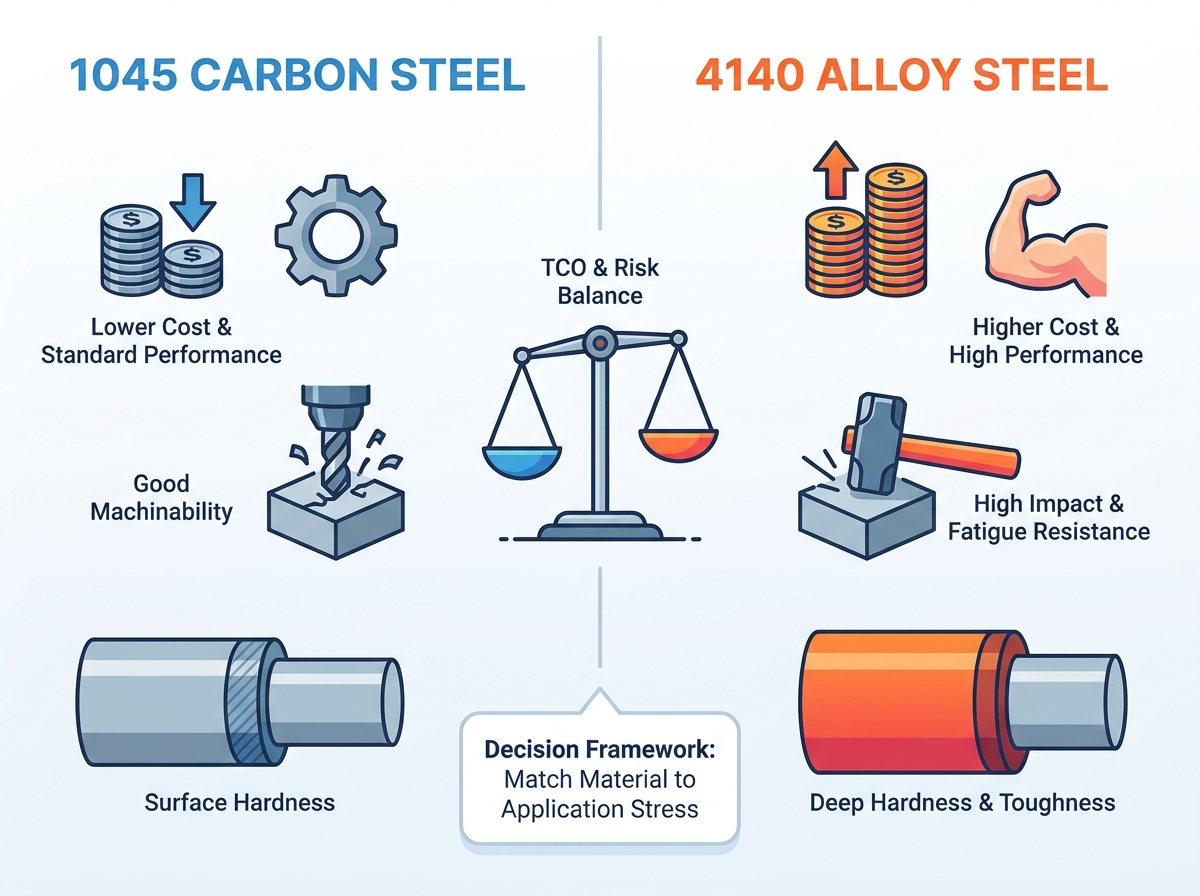
Baseline tensile and yield strengths separate these two metals immediately. The 4140 grade offers significantly higher strength limits right out of the mill. It resists deformation under extreme loads, maintaining structural integrity where simpler metals bend or warp. This makes it invaluable for lifting equipment and pressurized vessels. You must evaluate the cyclic loading environments of your specific application. Fatigue failure acts as the primary risk factor in rotating equipment. High-stress parts undergo thousands of load cycles daily. Each rotation applies tension and compression sequentially. Alloy variants handle these cyclic stresses without developing microscopic micro-fractures. They simply absorb the punishment better over long operational lifespans, reducing the frequency of scheduled maintenance replacements.
We define hardenability as a critical differentiator, especially in large-diameter components. It determines how deep a metal can harden during the quenching process. The 1045 grade suffers from shallow surface-hardening limits. While the outside case gets hard, the core often remains relatively soft and ductile. This creates a steep hardness gradient. We contrast this with 4140's unique thermal capabilities. Chromium and molybdenum additions allow it to achieve uniform hardness. This uniformity extends deeply through much thicker cross-sections. If you are designing a thick shaft that must withstand heavy torsion, this deep hardening prevents the core from shearing under pressure. Industry frameworks recognize this deep hardening ability as the primary reason to upgrade from plain carbon variants.
Tougher metals introduce distinct machining penalties that production managers hate. You will experience increased tool wear when cutting alloys. Operators must use slower feeds and speeds to prevent tool breakage and machine chatter. This extends production cycle times and reduces daily output. We also need to highlight implementation realities for welding. The 1045 grade is moderately weldable and forgiving for standard fabrication shops. The 4140 grade requires strict thermal controls. You must apply precise pre-heating protocols before striking an arc. You also need slow cooling routines afterward. Without these steps, the weld zone will likely crack from rapid thermal contraction.
Optimal Use Cases: Engineers frequently specify this grade for standard rotating parts. It excels as an electric motor shaft material. You will also find it in lightly stressed gears, agricultural axles, and general-purpose machinery components. It serves as the reliable workhorse of the industrial sector.
Performance Thresholds: This grade is entirely sufficient for numerous industrial applications. It works perfectly when parts require standard wear resistance. It handles moderate strength requirements effortlessly. If your component operates indoors under steady loads, this metal rarely fails.
Procurement Advantages: Buyers love this metal for its high market availability. You get predictable pricing and short lead times from almost any service center. It also boasts excellent machinability. This keeps production bottlenecks low and output high. Shops can turn, mill, and drill it rapidly without burning through expensive carbide tooling.
Failure Risks: Despite its benefits, it carries specific risks that designers must acknowledge. The metal is prone to distortion during aggressive heat treatment. Quenching it rapidly in water can cause severe warping. Furthermore, it suffers from insufficient core strength in large cross-sections. It may twist or snap under high torsional loads if pushed beyond its moderate limits.
Optimal Use Cases: This metal shines in punishing environments where lesser materials fail rapidly. We see it used heavily in oil and gas drilling components. It forms heavy automotive transaxles and aerospace forgings. It is the go-to choice for high-impact machine parts like crusher jaws and heavy-duty conveyor pins.
Sourcing Considerations: When purchasing a forged steel bar in 4140, pay attention to the delivery condition. Suppliers offer it annealed or pre-hardened (quenched and tempered). Pre-hardened stock saves heat-treating time but machines significantly harder. Annealed stock cuts easier but requires post-machining thermal treatments.
Performance Justification: The specific alloy additions justify the higher price tag. Chromium and molybdenum provide unmatched toughness against sudden shocks. They deliver superior abrasion resistance in gritty environments. They also maintain structural stability at high operating temperatures, preventing the metal from losing its yield strength when machinery gets hot.
Implementation Realities: Working with this metal demands advanced CNC capabilities. You need rigid workholding setups to prevent chatter during heavy cuts. It requires specialized welding procedures handled by certified technicians. All these factors increase the overall production timeline and associated labor costs. You must plan production schedules accordingly to avoid expensive delays.
Material Property Comparison Chart
Feature | 1045 Medium Carbon | 4140 Chromoly Alloy |
|---|---|---|
Primary Alloying Elements | Carbon, Manganese | Carbon, Chromium, Molybdenum |
Typical Yield Strength | ~45,000 - 77,000 PSI | ~60,000 - 100,000+ PSI |
Machinability Rating | Excellent (~76%) | Fair (~65%) |
Weldability | Moderate (Pre-heat recommended) | Difficult (Strict thermal controls required) |
Choosing the correct metal requires a systematic approach. You must weigh the mechanical demands against the project budget objectively. Emoting over "better" materials often leads to wasted funds. Use these guidelines to narrow down your selection based on hard operational data.
Choose 1045 if:
The component operates under consistent, predictable loads without sudden shocks or spikes in force.
Surface hardness is sufficient for the application, and core strength remains a secondary concern.
Minimizing machining time and raw material costs is critical to protecting your product margin in a highly competitive market.
Your fabrication team lacks the specialized equipment required for complex pre-heating and post-weld heat treatments.
Choose 4140 if:
The part faces high-impact collisions, severe torsional strain, or constant cyclic stress throughout its lifespan.
Deep, uniform hardening is absolutely mandatory for the component's large diameter to prevent core shear.
The cost of part failure in terms of downtime and safety vastly outweighs the initial forged steel bar cost premium.
Your application involves elevated temperatures where standard carbon grades would rapidly lose their structural integrity.
The final verdict comes down to your specific operational environment. The 1045 grade provides economical reliability for standard machinery. The 4140 grade delivers uncompromised durability for extreme applications. We highly recommend running a limited prototype if your application sits on the borderline between the two grades. Conducting a finite element analysis (FEA) can also reveal potential stress concentrations before manufacturing begins. Do not guess when safety and budgets are on the line. Request a material consultation with our metallurgy experts today. You can view our live inventory online or submit your specific spec sheet for a custom quote tailored to your exact project requirements.
A: Exact pricing fluctuates regularly based on global market conditions and mill availability. However, a 30% to 40% raw material premium for 4140 is standard across the industry. This baseline difference does not include the additional secondary processing expenses. Machining, heat-treating, and specialized welding will further increase the final component price.
A: No, it cannot fully match the alloy's performance. Carbon steel has severe hardenability limitations. While 1045 can reach a high surface hardness through induction hardening, its core remains relatively soft. It will always lack the deep core toughness, impact resistance, and high fatigue limit that chromium and molybdenum provide to 4140.
A: Yes, 4140 presents significantly more machining challenges. It holds a lower machinability rating, sitting at approximately 65% of standard carbon steel. Operators must adjust their equipment accordingly. You will need slower feeds, reduced spindle speeds, and highly rigid tooling to prevent rapid insert wear and maintain tight dimensional tolerances.


