


close
Choose Your Site
Global
Social Media
Views: 0 Author: Site Editor Publish Time: 2026-03-04 Origin: Site


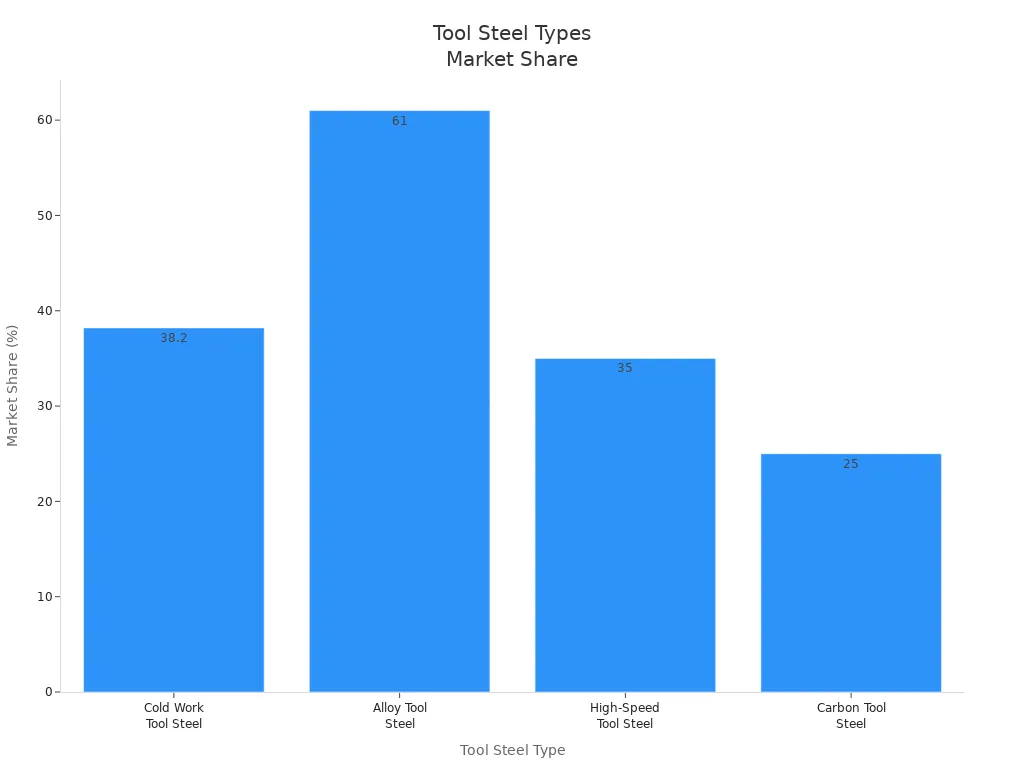
You often see cold work tool steel, alloy tool steel, high-speed tool steel, and carbon tool steel in factories, including applications for Tool Steel Forgings. The table below shows how much each type is used and what they are used for:
Tool Steel Type | Market Share (%) | Usage Description |
|---|---|---|
Cold Work Tool Steel | 38.2% | Used in cutting, stamping, and forming jobs. |
Alloy Tool Steel | 61% | Good for building parts and making tools. |
High-Speed Tool Steel | 35% | Best for fast cutting and machine work. |
Carbon Tool Steel | 25% | Used in hand tools and simple molds. |
It is important to pick the right tool steel for your job, especially when considering Tool Steel Forgings. You should think about hardness, toughness, heat resistance, wear resistance, machinability, and cost. These factors help your tools work well and last longer. Shandong Panjin Steel Pipe Manufacturing Co., Ltd. is known for its modern machines and skilled workers. They make strong seamless steel pipes for many industries.
Pick the right tool steel for your job. Cold work, hot work, and high-speed tool steels do different things.
Think about hardness, toughness, and wear resistance when you choose tool steel. These things affect how well the tool works and how long it lasts.
Check if the steel is easy to machine. This can help you save time and money. Steels that are easier to machine make production faster and cost less.
Look at the total cost of owning the tool. This means thinking about tool life and maintenance, not just the first price of the steel.
Check and take care of your tools often. This helps them work better and last longer. It also lowers downtime and the cost to replace them.
When picking tool steel for forging, you must check some important things. These things change how your tools work and how long they last. They help you choose the best tool steel for your job.
Hardness and strength show how well tool steel can stop bending and wearing out. If you need tools for cutting or stamping, you want high hardness. High carbon-chromium tool steel gives very high hardness and wear resistance. Air-hardening tool steel has good toughness and keeps its shape after heating. You use these types for dies, punches, and cutting tools. The table below compares tool steel categories:
Tool Steel Category | Hardness | Strength | Common Use |
|---|---|---|---|
Air-Hardening | High | High | Precision dies, punches |
High Carbon-Chromium | Very High | High | Shear blades, forming dies |
Hot-Work | Good at high temp | High | Forging dies, extrusion tools |
Toughness means tool steel can take hits without breaking. If you use chisels or hammers, you need shock-resisting tool steel. This type gives great toughness and impact resistance. Hot-work tool steel also stops cracking when used at high heat. Pick tool steel with the right mix of toughness and hardness for your job.
Heat resistance lets tool steel stay strong at high temperatures. Wear resistance means the tool lasts longer when rubbed or used a lot. Hot-work tool steel can handle up to 700°C, so it works well for forging dies and extrusion tools. Cold work tool steel has very high wear resistance, good for stamping dies and shear blades. High-speed tool steel is best for extreme wear resistance and can cut fast without losing hardness.
Machinability means how easy it is to shape tool steel into tools. Grades like P20 and O1 are easy to machine, so you can make molds and cutting tools quickly. H13 and D2 also have good machinability and extra wear resistance. If you want to save time and money, pick tool steel with better machinability.
Cost affects your whole project, not just the price of tool steel. You must think about tool life, maintenance, and how often you replace tools. Some tool steel types cost more but last longer, saving money over time. Shandong Panjin Steel Pipe Manufacturing Co., Ltd. uses advanced machines and strong research teams to make high-quality seamless steel pipes. Their focus on new ideas and quality helps you get the most value from your tool steel.
Tip: Always match tool steel properties to your forging needs. This helps your tools work better and last longer.
Criterion | Impact on Forging Performance |
|---|---|
Performance | Changes strength and reliability |
Process | Decides if steel fits your forging method |
Cost | Changes total project expense |
Composition | Matches steel to your end use |
Deformation | Keeps quality high during forging |
You should know the main types of tool steel for forging. Each type has special features and works best for certain jobs. If you learn about their good and bad points, you can pick the right tool steel grades for your tools.
Air hardening tool steel does not change shape much when heated. You do not need oil or water to cool it down. This makes it good for tools that need to stay the same shape. A2 and S7 are popular tool steel grades.
Tool Steel Type | Properties | Typical Applications |
|---|---|---|
A2 | Air-hardening, less distortion during heat treatment | Woodworking tools, punches, injection mould components |
S7 | Shock-resistant, built for impact toughness | Chisels, punches, heavy-duty tools |
A2 is used when you want tools to keep their shape. S7 is good for tools that get hit hard. Shandong Panjin Steel Pipe Manufacturing Co., Ltd. uses new machines to make seamless steel pipes for strong forging tools.
Oil hardening tool steel cools in oil. This gives it good wear resistance and toughness. O1 and O2 are common tool steel grades.
Grade | Advantages | Limitations |
|---|---|---|
O1 | Good wear resistance, toughness, easy to machine in the annealed state | May not achieve the same level of hardness as some other tool steels, limited performance in high-impact applications |
O2 | Similar to O1 with good wear resistance and toughness | Same limitations as O1 regarding hardness and impact resistance |
O1 is picked for cutting tools and dies. O2 works for the same kinds of jobs. These steels are easy to shape and grind. You save time and money using oil hardening tool steel for simple forging jobs.
Water hardening tool steel gets very hard. You cool it fast in water. This makes it brittle, so you should not use it for tools that get hit a lot. W1 is a popular tool steel grade.
Property/Characteristic | Description |
|---|---|
Hardness | Extremely high hardness achieved through water quenching |
Brittleness | Increased brittleness due to rapid cooling process |
Toughness | Lacks toughness, prone to cracking under impact |
Applications | Suitable for chisels, knives, woodworking tools, drills, collets, pipe cutters, forming dies, gauges, embossing dies, draw punches, bushings, forming rolls, wood augers |
Machinability | High machinability, one of the easiest grades to grind |
Cost | Relatively low cost compared to other tool steels |
You use water hardening tool steel for simple tools like chisels and knives. It is easy to grind and shape. You pay less for this steel, but it is not good for tough jobs.
Cold work tool steel is used for stamping, cutting, and forming at room temperature. D2 and D3 are popular tool steel grades. These steels have high wear resistance.
Steel Type | Wear Resistance | Toughness |
|---|---|---|
D2 | High | Moderate |
D3 | Superior | Lower |
D2 is used for forging dies that need to last a long time. D3 gives even more wear resistance but is not as tough. Cold work tool steel is best for jobs where tools rub and cut a lot.
Tip: Pick cold work tool steel if you want tools that do not wear out fast and keep their shape.
Hot work tool steel is used for forging at high temperatures. H13 is a popular tool steel grade. It stays tough and hard even when hot.
H13 has carbon, chromium, molybdenum, and vanadium. This mix keeps the steel hard up to 540°C (1000°F).
Molybdenum and vanadium make carbides that stop the steel from getting soft.
H13 stays strong when heated and cooled quickly.
Hot work tool steel is used for forging dies, die casting, and extrusion tools.
You pick hot work tool steel when tools need to handle heat and pressure. Shandong Panjin Steel Pipe Manufacturing Co., Ltd. uses advanced rolling lines to make steel pipes for hot forging tools.
High-speed tool steel is very hard and resists wear. M2 is a common tool steel grade. You use high-speed tool steel for tools that cut fast and stay sharp.
Characteristic/Application | Description |
|---|---|
High Hardness | M2 Tool Steel exhibits high hardness, essential for cutting tools operating at elevated speeds. |
Wear Resistance | The alloy's composition provides strong wear resistance, crucial for longevity in cutting applications. |
Red Hardness | M2 maintains hardness at elevated temperatures, making it suitable for high-speed machining. |
Thermal Stability | The steel's thermal stability supports performance in demanding environments, such as aerospace. |
Typical Applications | Drills, taps, milling cutters, tool bits, and components in aerospace and automotive manufacturing. |
Drills, Taps, and Milling Cutters | Ideal for tools that cut or shape metal under continuous rotation or impact. |
Tool Bits and Metalworking Inserts | Used in lathes and CNC machines for high-speed operations requiring edge retention and durability. |
Cold Forming Dies | Suitable for industrial dies that withstand repeated impact and maintain accuracy. |
Aerospace Components | Benefits from M2’s properties in machining high-strength alloys and heat-resistant metals. |
Automotive Manufacturing | Supports mass production in shaping engine and gearbox parts without edge degradation. |
Heavy Equipment Fabrication | Resists deformation and wear in tools exposed to continuous abrasion and pressure. |
You use high-speed tool steel for drills, taps, and cutters. It is also used in aerospace and car parts. These steels keep their edge and shape even when working fast and hot.
Note: Shandong Panjin Steel Pipe Manufacturing Co., Ltd. makes seamless steel pipes that help you build strong forging tools. The company uses new production lines and research centers to support high-quality tool steel products for many industries.
You need to know the good and bad sides of each tool steel category to pick the best one for your forging tools. Tool steel can stop rust a little, so it works in most places, but not near the ocean or with strong chemicals. Tool steel is strong and tough when it gets hot, so your tools do not break during hard jobs. Over time, tool steel can get rusty and scaly, so you should check your tools often.
Here is a table that shows the main good and bad points of cold-work and hot-work tool steels:
Tool Steel Category | Strengths | Weaknesses |
|---|---|---|
Cold-work Tool Steels | Excellent wear resistance, increased toughness, non-distorting | Hard to manufacture |
Hot-work Tool Steels | High yield strength, good corrosion resistance, resistant to softening | Susceptible to heat checks |
Cold-work tool steel does not wear out fast, but it is hard to make and shape. Hot-work tool steel stays strong in heat and fights rust, but cracks can show up after using it many times. You need to think about these things to help your tools work their best.
Tip: Tool steel stays strong and tough when hot, but you should watch for rust and scale that can make it weaker over time.
How hot you heat tool steel matters a lot. If you heat it too little, it can crack because it gets stiff. If you heat it too much, the steel can get rough inside and break more easily. You must heat tool steel just right to make it strong and last longer.
When you use the right heat, the inside of the steel stays good and your tools work better. You stop problems and make tools that last longer. Shandong Panjin Steel Pipe Manufacturing Co., Ltd. uses new machines and careful heating to make strong seamless steel pipes. Their smart research team helps you get steel pipes that are always good for forging and tool steel jobs.
Note: Always check how hot you should heat each tool steel grade. This helps you stop cracks and rough spots.
You want tool steel grades that do not bend or crack when forging. H13 and S7 are very tough and can take a lot of heat and stress. These grades are good for jobs like hot-work die steel and mold dies.
Here is a table that shows what they can do:
GRADE | PROPERTIES | APPLICATION |
|---|---|---|
H13 | Resists thermal fatigue cracking, hardenability, wear resistance | Hot-work die steel |
S7 | High shock resistance, toughness, easy heat treat and machinability | Mold dies |
H13 and S7 work well because they do not break when used again and again in hot jobs. These grades help your tools last longer and keep your work going.
H13 and S7 are tough and do not crack from heat.
You use them for tools that get used a lot and need to be strong.
Shandong Panjin Steel Pipe Manufacturing Co., Ltd. helps you with strong seamless steel pipes for forging. Their new machines and full process make sure you get steel pipes that work well in many jobs. You get good tools because the company works hard to make better products and keep quality high.
Callout: Pick tool steel grades that do not bend or crack for hard forging jobs. This makes your tools work better and saves time.
Shandong Panjin Steel Pipe Manufacturing Co., Ltd. is a top company in the steel business. They have big factories and smart research teams. The company makes seamless steel pipes, forging dies, and machine dies. Their workers use new machines to make tool steel forgings for many jobs. This helps you pick the right tool steel for your work.
For heavy-duty forging, you need tool steel that is very hard and does not wear out fast. These grades stay strong when hot and do not bend under pressure. You use them in tough places where tools must last a long time. The table below shows what is good and bad about these steels:
Advantages | Limitations |
|---|---|
Exceptional hardness and wear resistance | Brittle compared to other steels |
Retains strength at elevated temperatures | Expensive and difficult to machine |
Long service life in demanding environments | Requires precise heat treatment |
Resistant to deformation under load | N/A |
You pick these grades for forging dies and jobs that need strong tools.
Precision tooling needs tool steel that is tough, does not wear out, keeps a sharp edge, is hard, and stays hard when hot. You want tools that can take hits, do not break, and stay sharp. The tables below show the main things you need:
Property | Description |
|---|---|
Toughness | Absorbs energy, resists fracture under impact |
Property | Description |
|---|---|
Wear Resistance | Resists surface degradation from friction and abrasion |
Property | Description |
|---|---|
Edge Retention | Maintains sharp edge during use |
Property | Description |
|---|---|
Hardness | Resists deformation and scratching, exceeds 60 HRC |
Property | Description |
|---|---|
Temper Resistance | Retains hardness at elevated temperatures |
You use these grades for machine dies and tools that need to be very exact.
For high-volume production, you need tool steel that lasts through many uses. H13 and D2 are good choices. These grades do not wear out fast and stay strong when hot. You use them for forging dies and punches in big production runs.
Tool Steel Grade | Key Features | Applications |
|---|---|---|
H13 | High wear resistance, thermal stability | Die casting dies, forging dies |
D2 | Very high wear resistance, retains hardness up to 425°C | Punches and dies for long production runs, cold extrusion tools |
You trust these grades when you want tools to last and work the same every time.
Some jobs need special tool steel with different features. You find grades with more or less carbon for machine parts, chisels, setscrews, forging dies, hammers, sledges, files, small drills, lathe tools, and razor blades. The table below shows common grades and what they are used for:
Grade | Carbon Content | Typical Applications |
|---|---|---|
W-steels (0.60–0.75% C) | 0.60–0.75% | Machine parts, chisels, setscrews |
W-steels (0.76–0.90% C) | 0.76–0.90% | Forging dies, hammers, sledges |
W-steels (0.91–1.10% C) | 0.91–1.10% | General purpose tooling applications |
W-steels (1.11–1.30% C) | 1.11–1.30% | Files, small drills, lathe tools, razor blades |
O series (oil-hardening) | N/A | Used for cutting/forming materials at low temperatures |
A series (air-hardening) | N/A | Used for parts requiring minimal distortion during hardening |
D series (high carbon-chromium) | N/A | High wear resistance, used in larger parts production |
P20: Used for diecasting dies and injection molds.
D2: Has better wear resistance and higher strength.
H13: Air-hardening and does not crack from heat.
You match tool steel grades to each job for the best results and longer tool life.
You should check the price of each tool steel before picking one. Some grades cost more because they have special parts or need extra heat treatment. Water hardening steel is cheaper, but it does not last as long as others. Air hardening and hot work grades cost more money. They are better at fighting wear and keep their shape after heating. When you choose tool steel, think about both the price and how long the tool will last.
Shandong Panjin Steel Pipe Manufacturing Co., Ltd. makes seamless steel pipes that are high quality. The company uses new machines and smart research teams to make products that help you save money over time. You get pipes that work for many jobs, like engineering and shipbuilding.
Tool Steel Type | Cost Level | Typical Use |
|---|---|---|
Water Hardening | Low | Simple tools |
Oil Hardening | Medium | Cutting and forming tools |
Air Hardening | High | Precision dies, punches |
Hot Work | High | Forging dies, extrusion |
You want your tools to last a long time. Tool steel with high wear resistance and good heat treatment stays strong and sharp. Cold work grades fight wear but need careful treatment so they do not crack. Hot work grades need special care to handle high heat. You should check your tools for cracks and clean them after every use. This helps your tools work well.
Shandong Panjin Steel Pipe Manufacturing Co., Ltd. is known for seamless steel pipes that help tools last longer. The company uses advanced production lines and checks quality to help you have less downtime and spend less on new tools.
Tip: Always use the right heat treatment for each tool steel grade. This helps your tools fight wear and last longer.
The tool steel you pick changes your whole forging job. You can work faster and save money if you choose steel that lasts and needs less fixing. You also stop work less often and keep making things. Here are some ways your choice helps your business:
You make tools work better and forging goes faster.
You have less downtime because strong steel breaks less.
You spend less on new tools and get more work done.
Shandong Panjin Steel Pipe Manufacturing Co., Ltd. uses new technology and a full industry chain. You get seamless steel pipes that help your tools work better and support good forging.
You need clear facts to choose the right tool steel for forging. A comparison table helps you see the differences quickly. You can check chemical composition, heat treatment, hardness, and common uses. This makes your decision easier and helps you match steel to your job.
Tip: Look at each steel’s properties before you decide. This saves time and money.
Tool Steel Type | Chemical Composition | Heat Treatment Parameters | Rockwell Hardness | Typical Applications |
|---|---|---|---|---|
Air Hardening (A2) | 1% C, 5% Cr, 1% Mo | Harden at 960°C, temper at 200°C | 57–62 HRC | Punches, dies, injection molds |
Oil Hardening (O1) | 0.9% C, 1% Mn, 0.5% Cr | Harden at 800°C, temper at 150°C | 56–62 HRC | Cutting tools, forming dies |
Water Hardening (W1) | 0.7–1.0% C, trace Mn | Harden at 780°C, temper at 150°C | 60–64 HRC | Chisels, knives, woodworking tools |
Cold Work (D2) | 1.5% C, 12% Cr, 0.8% Mo | Harden at 1000°C, temper at 200°C | 58–62 HRC | Stamping dies, shear blades |
Hot Work (H13) | 0.4% C, 5% Cr, 1.3% Mo, 1% V | Harden at 1020°C, temper at 550°C | 50–55 HRC | Forging dies, extrusion tools |
High-Speed (M2) | 0.9% C, 4% Cr, 6% W, 5% Mo | Harden at 1200°C, temper at 550°C | 62–65 HRC | Drills, taps, milling cutters |
You see that each tool steel has a special mix of elements. This changes how the steel acts when you heat it. Hardness tells you how well the steel fights wear. Typical applications show where you use each type.
Shandong Panjin Steel Pipe Manufacturing Co., Ltd. stands out in the steel industry. The company has strong research teams and advanced machines. You benefit from seamless steel pipes made with high-quality standards. The company produces pipes for engineering, machinery, oil, and shipbuilding. Its location near ports and highways makes delivery fast and easy.
Note: Shandong Panjin Steel Pipe Manufacturing Co., Ltd. uses modern production lines and a full industry chain. You get reliable steel pipes that support forging and tool steel needs.
You can use this table to compare tool steels and pick the best one for your forging job. Always match the steel’s properties to your application for the best results.
You can pick the right tool steel forgings by thinking about your job. H13 is good for hot-work because it stays strong when heated. S7 is best for tools that get hit a lot. D2 is used for cutting and works well with rough materials. A2 is simple to sharpen again and again. 440C does not rust easily, even when it is wet. The table below lets you see how each type is different:
Tool Steel Type | Common Applications | Durability | Cost | Maintenance |
|---|---|---|---|---|
H13 | Hot-work forging | High | High | Moderate |
S7 | Impact tools | High | Moderate | Low |
D2 | Cutting tools | High | Moderate | Moderate |
A2 | Resharpening jobs | Moderate | Moderate | Low |
440C | Corrosive settings | Moderate | High | Moderate |
Tip: Think about how well the tool works, how much it costs, and how often you need to take care of it. This helps your tools last longer. Shandong Panjin Steel Pipe Manufacturing Co., Ltd. gives you strong seamless steel pipes and expert help for your forging jobs.
Dies shape metal during forging. You use dies to press, cut, or form steel into the right shape. Dies help you make parts quickly and accurately. Shandong Panjin Steel Pipe Manufacturing Co., Ltd. produces seamless steel pipes that support strong dies for many industries.
You look for tool steel with high hardness and toughness. Dies need to resist cracking and wear. For jobs needing maximum wear resistance, you pick grades like D2 or H13. Shandong Panjin Steel Pipe Manufacturing Co., Ltd. offers steel pipes that help dies last longer.
Maximum wear resistance lets dies work longer without breaking down. You save money and time because you replace dies less often. Dies with maximum wear resistance help you keep production running smoothly. Seamless steel pipes from Shandong Panjin Steel Pipe Manufacturing Co., Ltd. support durable dies.
You clean dies after each use. You check for cracks or wear. You use proper heat treatment to keep dies strong. Shandong Panjin Steel Pipe Manufacturing Co., Ltd. uses advanced technology to make steel pipes that help dies stay reliable in tough jobs.
You can use some dies for different jobs, but you must match the tool steel to each task. Dies for hot forging need special grades. Dies for cold work need high wear resistance. Shandong Panjin Steel Pipe Manufacturing Co., Ltd. supplies steel pipes for all kinds of dies.


