
Please Choose Your Language


close
Choose Your Site
Global
Social Media
Views: 0 Author: Site Editor Publish Time: 2026-03-26 Origin: Site


Forged steel bars are very important in mechanical engineering. Makers form these bars by pressing iron and carbon together with a lot of heat and force. This process makes parts that are very strong and last a long time. Forged steel is tough and works well in hard places. It helps make important parts stronger. Many industries use these bars. Some examples are automotive, aerospace, construction, shipbuilding, and railway. They use them for gears, axles, beams, and reinforcement bars. Modern forged steel is very useful and dependable. People choose it when safety and lasting strength are needed most. In 2024, the global metal forging market was worth USD 94.88 billion. The automotive industry used 42.5% of this amount. This shows how important forged steel is today.
Industry | Description |
|---|---|
Automotive | Used for important parts like crankshafts and gears. These parts help cars work well and stay safe. |
Aerospace | Used in strong parts like landing gear and engine parts. These parts must be reliable. |
Tool Manufacturing | Needed for hand tools. These tools must be strong and last through many uses. |
Construction | Used in piles and beams for buildings. These parts help make buildings strong. |
Oil and Gas | Needed for drill bits and valves. These parts keep extraction and moving oil and gas safe. |
Shipbuilding | Used for marine parts like propellers. These parts must last in tough water conditions. |
Railway | Used in wheels and axles. These parts help trains run safely and reliably. |
Forged steel bars are very important in mechanical engineering. They are strong and last a long time. This makes them good for important jobs.
Making forged steel bars needs heating, shaping, and cooling. The bars are also tested to make sure they are good and reliable.
These bars are used in many industries. They are found in cars, airplanes, and buildings. The bars are used for parts that must handle heavy weight and stress.
Forged steel bars work better than cast or machined parts. They are stronger, tougher, and resist damage from repeated use.
Buying forged steel bars can save money over time. They last longer and need fewer repairs or replacements.
Forged steel bars are very important in mechanical engineering. People make these bars by using heat and force to shape steel. This makes the bars strong and dependable. The forging process changes the inside of the metal. This helps the bars become tougher for hard work. Many industries use these bars because they last a long time.
Making forged steel round bars has many steps. Each step helps the bars stay strong and high quality.
Heating: Workers heat the steel billet until it is very hot. This makes the metal soft and easy to shape.
Forging: They shape the hot billet in different ways. These ways include open-die forging, closed-die forging, and press forging. Each way gives the bars special features.
Controlled Cooling: The bars cool down slowly and carefully. This keeps the bars strong and stops cracks from forming.
Heat Treatment: The bars go through steps like annealing, quenching, and normalizing. These steps make the bars tougher and harder.
Machining and Finishing: Workers cut and finish the bars to the right size and shape. This gives the bars a smooth surface.
Inspection and Testing: Quality control is very important. Workers use ultrasonic testing, magnetic particle inspection, and mechanical tests to check for problems.
Packaging and Delivery: The finished bars are packed and sent to customers.
New technology has made forged steel round bars even better. New machines and ways of making them help the bars get stronger. These changes also help stop mistakes and make the bars last longer. The forging process lines up the grains inside the steel. This gives the bars extra strength for tough jobs.
Tip: Quality control checks, like ultrasonic testing, help make sure every bar is safe and ready for use in important machines.
Forged steel round bars come in many types and sizes. Each type is good for different jobs. The round bar is the most common, but there are also square, flat, and hexagonal bars. Forged steel round bars are stronger and tougher than other steel bars.
The table below shows how forged steel round bars are different from regular round steel:
Property | Forged Steel Round Bars | Round Steel |
|---|---|---|
Manufacturing Process | Made by forging, which makes them stronger | Usually made by rolling or extrusion |
Mechanical Properties | Higher strength, toughness, and fatigue resistance | Lower strength, not good for heavy work |
Applications | Used in aerospace, automotive, and heavy machinery | Used in construction and general engineering |
Cost | More expensive because they are harder to make | Cheaper and easier to find |
Surface Finish | Rougher surface, may need more work | Smoother surface, easier to use |
Forged steel round bars are used in many industries. They are used for parts that need to handle a lot of stress, like gears, axles, and shafts. These bars are picked because they can resist wear and fatigue. Workers can order forged steel round bars in many sizes and grades. The table below lists some standard specifications:
Attribute | Specification |
|---|---|
Steel Grades | EN24, EN19, EN8D, C45, 34CrNiMo6, 42CrMo4, AISI 4140, AISI 4340, Tool Steel Grades |
Diameter Range | 100 mm to 800 mm (custom forging up to 1000 mm available) |
Length | 1 to 6 meters (custom cut-to-length available) |
Forging Type | Open Die / Closed Die / Press Forged |
Surface Condition | As Forged / Rough Machined / Proof Machined |
Heat Treatment | Annealed / Normalized / Hardened & Tempered |
Standards | ASTM, EN, DIN, IS, SAE, AISI |
Forged steel round bars give engineers many choices. They can pick the right size, grade, and finish for each job. These bars help make cars safe, bridges strong, and machines reliable. Forged steel round bars are the best choice when strength and safety are very important.
Forged steel bars are strong and last a long time. The forging process changes the steel inside. This makes the bars tough. They can hold heavy loads. Grade 316 stainless steel has special parts in it. It does not rust easily. It stays strong even when it gets hot. These features help the bars last longer. They also keep machines safe.
The table below shows how forging makes steel bars better and stronger:
Mechanical Property | Description | Contribution to Strength and Durability |
|---|---|---|
Grain Structure Refinement | Forging lines up the grains inside the bar. It makes a smooth grain pattern. | This makes the bar tougher. It helps the bar take hits and carry heavy weight. |
Impact Resistance | Forged steel can take sudden hits without breaking. The grains are smooth and there are no big flaws. | The bar can handle shocks and sudden stress. |
Durability | Forged bars do not bend or crack easily. They work well in hard places. | The bars last longer. They need less fixing and less time off. |
Tests in labs show forged steel bars like 42CrMo4 last over 10,000 units. Other materials, like 37CrMoV5-1 steel, do not last as long. This means forged steel bars work longer and stay strong in tough jobs.
Forged steel bars resist wear and fatigue very well. The forging process makes the steel inside more even. This helps the bars fight damage from use again and again. Many engineers pick forged steel for moving parts. These parts face friction every day.
The table below compares forged steel bars to other materials:
Aspect | Forged Steel Bars | Other Materials |
|---|---|---|
Lifespan Increase | Up to 30% | N/A |
Fatigue Resistance | Superior | N/A |
Wear Resistance | Enhanced | N/A |
Microstructure Homogeneity | Present | N/A |
Forged steel bars can take energy from shocks and shakes. This keeps them from breaking when stressed again and again. Good quality bars help stop failures. They keep machines working longer.
Forged steel bars are better than cast or machined parts. They are stronger. They last longer under stress. They have fewer flaws. The forging process makes the grains inside tight. This gives the bars more strength. It also makes them more reliable.
The table below shows the main differences:
Performance Metric | Forged Steel Bars | Cast Steel / Cast Parts |
|---|---|---|
Tensile Strength | 26% higher than cast parts | Lower tensile strength |
Fatigue Strength | 37% higher, so they last 6 times longer | Lower fatigue strength |
Yield Strength | 100% (baseline) | 66% of forged steel yield strength |
Reduction in Area at Failure | 58% reduction (bars bend more before breaking) | 6% reduction (bars bend less) |
Grain Structure | Tight, smooth grain flow that fits the shape | Rough, random grain structure |
Defects | No holes or cracks inside | Holes and cracks are common |
Impact Resistance | Better toughness and flexibility | Lower toughness and flexibility |
Wear Resistance | High wear resistance without extra hard metals | Needs harder metals for same wear |
Mechanical Reliability | High, best for important jobs | Lower reliability under stress |
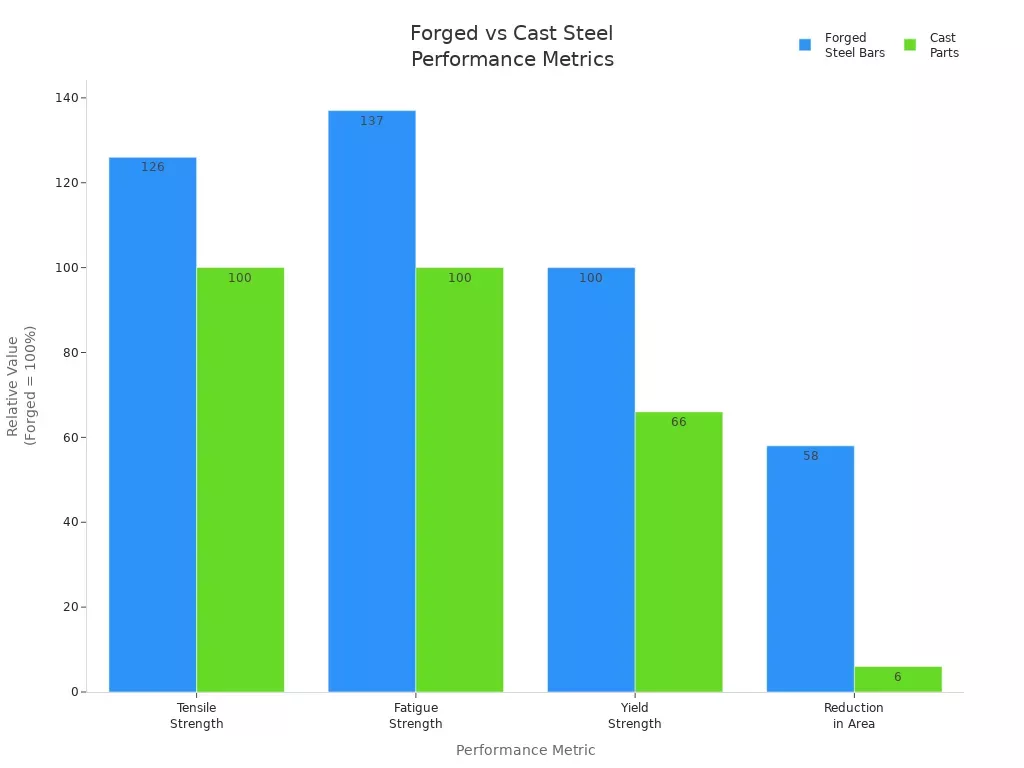
Forged steel bars have fewer flaws and better quality than other types. This makes them the best choice for parts that need to be strong and last a long time.
Forged steel bars are used in many industries. They are strong, tough, and reliable. This makes them a top choice for parts that need to last. These bars work well under stress. The next parts show how different industries use these bars and why they matter.
Automotive and aerospace companies use forged steel bars for important parts. These industries need materials that can handle heavy loads. The bars must also resist wear and keep people safe.
In cars, forged steel bars become crankshafts, connecting rods, and gears. These parts face a lot of stress and must last many years. The bars help cars work better and stay safe.
In airplanes, forged steel bars are used for landing gear and engine parts. These parts face strong forces during takeoff and landing. The bars give the strength and safety needed for flying.
The main reasons to use forged steel bars are:
They are stronger because of their grain structure. This helps parts not break or bend.
They are tough, so they can take hits and keep working.
The quality is always the same, so every part is safe.
They help companies save money and make cars faster.
They are lighter and more exact, which is good for planes.
Lately, more people are buying cars, especially electric ones. More people are flying, so the aerospace industry is growing too. Both industries use forged steel bars for parts like crankshafts, axles, landing gear, and engine parts.
The construction industry uses forged steel bars in many ways. These bars help make buildings and bridges strong and safe. They are used for building foundations, frameworks, bridges, and tall buildings.
Steel bridges use forged steel bars for support. These bridges are found in cities, highways, and over rivers.
Workers use the bars in building foundations to keep buildings safe and upright.
The bars are also used in frameworks for tall buildings and city bridges. Some bridges, like steel box girder bridges, can be built fast without stopping traffic.
Forged steel bars must meet strict rules in construction. For example, IS 1786:2008 gives rules for steel bars used in concrete. Some places need BIS certification to sell these bars. Tests like ladle analysis, tensile tests, and bend tests make sure the bars are safe and strong.
Builders like these bars because they are strong, do not bend easily, and last a long time. They help keep buildings and bridges safe for everyone.
Shipbuilding, railway, and factories also use forged steel bars for many jobs. These industries need bars that can handle hard work and heavy loads.
Industry | Application | Material Grades | Technical Requirements |
|---|---|---|---|
Shipbuilding | Marine propeller shafts, boiler parts | 316L stainless steel, 42CrMo4 alloy steel | Must resist saltwater and pass many tests |
Railway | Locomotive axles, wagon axles | AISI 1045 carbon steel | Needs quenching and tempering, and strict checks |
Heavy Machinery | Custom forged rolls, die inserts | Various grades including AISI 1045 | Needs high strength, toughness, and heat treatment |
Shipbuilders use forged steel bars for propeller shafts and boiler parts. These bars must not rust in saltwater and must pass many tests. Railways use the bars for locomotive and wagon axles. These parts need special heat treatments to last longer and handle stress. Factories use the bars for custom rolls and die inserts. They pick different grades and heat treatments for the right strength.
Quality checks include chemical tests, strength tests, ultrasonic tests for inside problems, and hardness tests. Heat treatments like annealing, normalizing, solution treatment, aging, and quenching and tempering help the bars work for each job.
Factories use forged steel bars for machine parts, tools, and equipment. These bars help machines work safely and smoothly. The bars are also used in the pharmaceutical industry, where clean and strong materials are needed for safe work.
Note: Forged steel bars help many industries by giving the strength, toughness, and reliability needed for hard jobs.
Engineers pick forged steel bars because they work better than cast or machined parts. The forging process changes the steel inside. It lines up the grains with the bar’s shape. This makes the bars stronger and more dependable. Forged steel does not have empty spaces or weak spots inside. Other steel types can have these problems. Forged steel bars are tougher and last longer. They can handle heavy loads and lots of use.
Property | Forged Steel | Cast Parts |
|---|---|---|
Tensile Strength | Superior | Generally lower |
Toughness | Higher | Can be brittle |
Ductility | Better | Less ductile |
Fatigue Resistance | Enhanced | Lower |
Forgings have grains that make them strong and tough.
They do not bend easily when under stress.
Forged steel bars last longer because they have fewer weak spots.
Forged steel bars cost more at first. But they save money over time. The forging process makes bars that are strong and last longer. This means you do not need to fix or replace them as often. Billet steel is cheaper at the start, but it wears out faster. Forgings waste less metal, which saves money on big jobs. Machined parts waste more metal and use more steel. Over time, forged steel bars help lower the total cost.
Property | Billet Steel | Forged Steel |
|---|---|---|
Cost | Lower initial cost | Higher initial cost, better longevity |
Forged steel bars are more reliable.
They last longer, so you replace them less.
Using less metal helps keep costs down.
Many industries use forged steel bars for important jobs. High-speed shafts need these bars for strength. Heavy-duty fasteners made from forgings last a long time. Car companies use forged steel for crankshafts and connecting rods. These parts must take a lot of stress and use. In the Arctic, oil and gas workers use forged steel bars in pipelines and drills. These bars work in cold and high-pressure places. Cryogenic storage tanks use forged bars because they stay strong in the cold.
Note: Forged steel bars are strong, last longer, and work well in hard places.
Forged steel bars are very strong and useful. They save money and can be used in many ways. Many industries use these bars to keep things safe and working for a long time, as shown in the table below:
Advantage/Use | Description |
|---|---|
Cost-Effectiveness | Carbon steel bars give good value for money. |
Durability | These bars do not wear out fast and last in hard jobs. |
Versatility | Bars are used in construction, cars, and planes. |
Availability | Materials for bars are easy to find. |
Environmental Benefit | Bars can be recycled and use less energy. |
Power plants, pipelines, and aerospace companies use these bars for important parts. New technology and computer tools will help make bars even stronger. Picking good bars helps keep people safe and machines working well.
For special engineering jobs, experts say you should talk to trusted suppliers to pick the best bars for your project.
Forged steel bars have a tighter grain structure. This gives them more strength and toughness. Regular steel bars often have lower strength and may not last as long in tough jobs.
Engineers use these bars in cars, airplanes, bridges, and ships. They choose these bars for parts that need to handle heavy loads and resist wear.
These bars help prevent sudden breaks or failures. Their strong structure keeps machines and buildings safe. Many industries trust these bars for critical parts.
Manufacturers can make bars in many sizes, shapes, and grades. This helps engineers pick the right bars for each project, from small tools to large machines.
Forged steel bars last longer and need fewer repairs. Their strength means less downtime for machines. This saves money on maintenance and replacement.


