
Please Choose Your Language


close
Choose Your Site
Global
Social Media
Views: 0 Author: Site Editor Publish Time: 2026-03-09 Origin: Site


You will often see tool steel grades like H13, H11, H21, A6, A2, D2, and O1 used for forging tools. Each grade has its own strengths. For example, H13 and H11 can handle high heat. This makes them good for hot forging dies. Grades like D2 and A2 are very strong against wear. This helps them last longer in cold work. You need to compare grades by numbers. Look at wear resistance, toughness, heat resistance, machinability, and cost. Tool Steel Forgings fit into three main groups: cold work, hot work, and high-speed types. Each type is best for a different forging job. Shandong Panjin Steel Pipe Manufacturing Co., Ltd. helps with these needs. They use advanced production and strong research skills.
Pick the right tool steel grade for your forging job. Hot work grades like H13 and H11 work well in high heat. Cold work grades like D2 and A2 are good for wear resistance.
Focus on wear resistance when you pick tool steels. High wear resistance makes tools last longer. This lowers replacement costs and cuts down on downtime.
Think about toughness for your tools. Tough steels like H13 and A2 do not crack or chip easily. This helps your tools last longer when you use them.
Look at machinability to save time and money. Steels that are easier to machine work better as tools. They also help lower production costs.
Check the cost and if the steel is easy to get before you choose. Some grades cost less or are easier to find. This can affect your total budget.
When you pick Tool Steel Forgings, you should think about a few main things. These things change how your tools work and how long they last. Let’s look at these important points.
Wear resistance means how well a tool can be used many times without getting worn out. In forging, tools get pushed and rubbed a lot. If you choose steel with high wear resistance, your tools will last longer. You will not need to replace them as often. Cold work tool steels like D2 and A2 need high wear resistance. They are used to shape hard materials. Hot work tool steels like H13 also need wear resistance. But they also need to handle heat well.
Tip: About 70% of tool problems come from wear or bending. Picking the right steel and using good oil can help your tools last longer.
Toughness shows how well a tool can take hits and not break or chip. You want your forging tools to have high toughness. This is important when tools get hit or shocked. Hot work grades like H13 and H11 have good toughness. This helps them when the temperature changes fast. Cold work grades like O1 and A2 also need toughness. They need to stop cracks from forming after many uses.
Benefit | Description |
|---|---|
Fatigue resistance | Handles many uses without breaking |
Toughness | Stops cracks and chips |
Structural integrity | Keeps its shape even when it is big |
Heat resistance means your tool stays strong and hard when it gets hot. This is very important for hot forging. In hot forging, tools get very hot. Hot work tool steels like H13, H11, and H21 stay hard up to 540°C (1000°F) or more. Cold work steels do not need as much heat resistance. They are used at lower temperatures.
Heat resistance is how well the tool stays hard when hot.
Good heat treatment makes this better and helps tools last longer.
Machinability tells you how easy it is to cut or shape a tool steel. If a steel is easy to machine, you save time and money. Harder and tougher steels are harder to machine. Hot work steels like H13 are harder to machine than cold work grades like O1. You should check machinability before you pick a steel.
Good machinability means your tools last longer, look better, and cost less.
Cost and availability matter when you pick Tool Steel Forgings. Some grades are cheaper or easier to find in some places. For example, H10 might be easy to get nearby. This can help you save money. Always check if you can get the steel you want and if it fits your budget.
Tool Steel Grade | Availability Consideration | Performance Characteristics |
|---|---|---|
H10 | Easy to find locally | Works well for forging dies |
1.2365 | Found in some regions | Good for tough jobs |
SKD7 | Compared for best use | Needs good heat treatment for long life |
Shandong Panjin Steel Pipe Manufacturing Co., Ltd. is a leader in the field. They have strong research, new machines, and a full production line. Their seamless steel pipes and skills help make high-quality Tool Steel Forgings for many industries.
You use hot work tool steels when you need tools that can handle high temperatures. These grades work well in hot forging, die casting, and extrusion. H13, H11, and H21 are the most common hot work grades. They keep their hardness and strength even when they get very hot. This means your tools will not soften or crack easily.
H13 gives you excellent toughness and wear resistance. It stays hard up to 540°C. You can use it for die casting, extrusion dies, and hot shear blades.
H11 is similar to H13 but has a bit less molybdenum. It works well for hot forging dies and tools that need to resist cracking.
H21 contains more tungsten. It handles even higher temperatures. You can use it for hot-working dies and tools that face extreme heat.
Here is a table that shows the main properties of these hot work grades:
Steel Grade | Hardness (HRC) | Toughness (J) | Heat Resistance (°C) | Main Use Cases |
|---|---|---|---|---|
H13 | 0.32–0.45 | 4.75–5.50 | 1.10–1.75 | Die casting, extrusion, forging dies |
H11 | 0.30–0.42 | 4.75–5.50 | 1.1–1.4 | Hot forging dies, tools for thermal shock |
H21 | 0.26–0.40 | 3.00–3.75 | 8.5–10 | Hot-working dies, extreme heat tools |
Note: The numbers above show how each grade performs in hardness, toughness, and heat resistance. Higher numbers mean better performance in that area.
Cold work tool steels are best for tools that shape or cut materials at room temperature. You use these grades for cutting, blanking, and forming tools. They do not need to handle high heat, but they must resist wear and keep their shape.
A2 hardens in air. It gives you good wear resistance and keeps its size after heat treatment. You can use it for shear blades and molding dies.
D2 has high carbon and chromium. It gives you very high wear resistance. You use it for punches, dies, and industrial knives.
O1 hardens in oil. It is easy to machine and works well for general purposes.
A6 also hardens in air. It is tough and resists cracking.
Here is a table that shows the hardness of these cold work grades:
Tool Steel Grade | Rockwell C Hardness |
|---|---|
A2 | 57-62 |
D2 | 54-61 |
O1 | 58-60 |
A6 | 54-60 |
You can see that cold work grades have high hardness. This helps your tools last longer when cutting or shaping hard materials.
A2: Air hardening, good wear resistance, stable size.
D2: High carbon, high chrome, very high wear resistance.
O1: Oil hardening, easy to machine, general use.
A6: Air hardening, tough, resists cracking.
You can compare hot work and cold work tool steels by looking at their key properties. The table below shows how they differ:
Property | Hot Work Tool Steel | Cold Work Tool Steel |
|---|---|---|
Temperature Resistance | Designed for high temperatures | Not designed for high temperatures |
Applications | Die casting, hot forging, extrusion tooling | Cutting, blanking, forming tools |
Key Characteristics | Resists thermal fatigue and softening | High wear resistance, strong under pressure |
Now, look at this table to see how the main grades compare in hardness, toughness, and heat resistance:
Tool Steel Grade | Hardness (HRC) | Toughness | Heat Resistance |
|---|---|---|---|
H13 | 54 | N/A | Resists thermal fatigue cracking |
H11 | 54 | N/A | Good |
H21 | N/A | N/A | Very high |
A2 | 63 | N/A | N/A |
D2 | 63 | N/A | N/A |
O1 | 65 | N/A | N/A |
A6 | 54-60 | N/A | N/A |
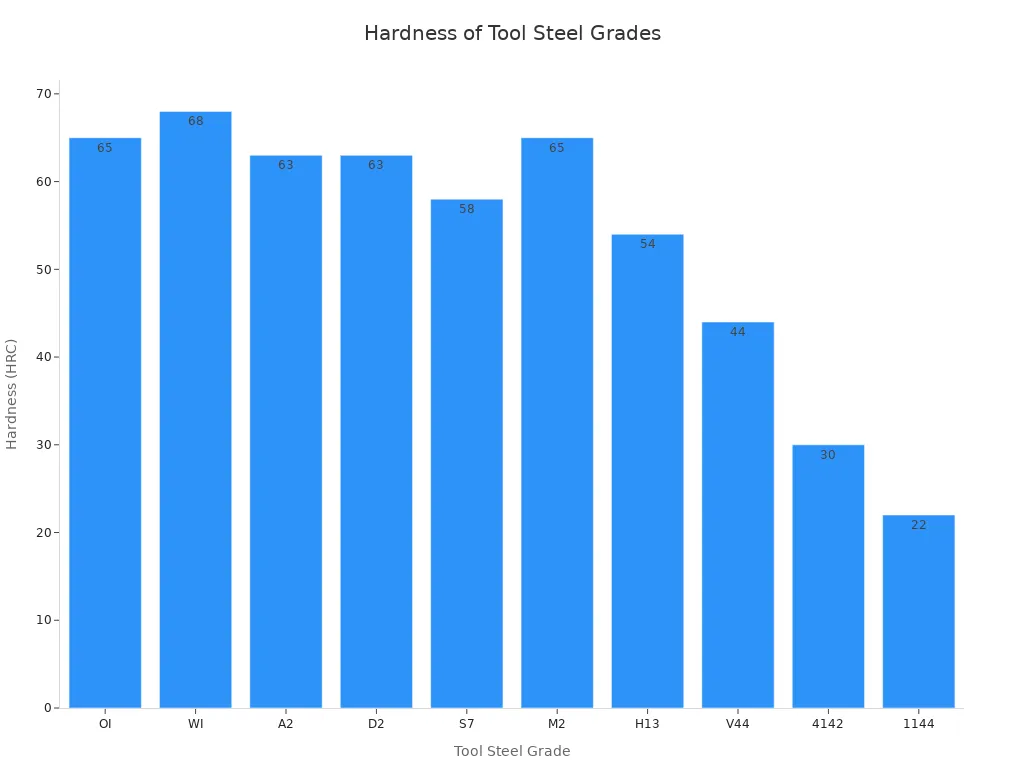
Tip: Hot work grades like H13 and H11 give you better performance at high temperatures. Cold work grades like D2 and A2 give you higher hardness and wear resistance for room temperature jobs.
You should choose hot work tool steels when your tools face high heat and thermal shock. These grades resist softening and cracking. You should choose cold work tool steels when you need high wear resistance and strength at room temperature. These grades keep their edge and shape for a long time.
Tool Steel Forgings give you many options for different forging jobs. If you need help choosing the right grade, you can look at the numbers in the tables above. You can also ask experts for advice.
Shandong Panjin Steel Pipe Manufacturing Co., Ltd. stands out in the field of Tool Steel Forgings. The company has strong research and development centers, advanced equipment, and a full production line. You benefit from their seamless steel pipes and high-quality products. Their factory sits near major ports and highways, making delivery fast and easy. The company produces a wide range of steel pipes for engineering, machinery, oil, chemical, and shipbuilding. Their focus on innovation and quality helps you get the best results for your forging needs.
Shandong Panjin Steel Pipe Manufacturing Co., Ltd. is a trusted company in forging. You get help from their advanced machines and strong factories. They make many kinds of products. The company is known for making seamless steel pipes that work well for many forging jobs.
Hot forging shapes metal when it is very hot. You need tool steels that do not get weak from heat. Hot work grades like H13, H11, and H21 are good for this. These grades make tools last longer and stop them from cracking.
Here is a table that shows what each tool steel is used for in hot forging:
Tool Steel | Common Applications |
|---|---|
H13 | Aluminum extrusion dies, die casting dies, heavy duty compression tools, forming punches, hot forging dies, shear blades, plastic mold dies, bolt dies |
H11 | Hot forging dies, tools for thermal shock |
H21 | Hot-working dies, die casting, extrusion, hot-forming of parts |
H13 is used for many hot forging jobs. H21 is best when you need to handle very high heat.
Cold forging shapes metal at room temperature. You need tool steels that are tough and do not wear out fast. Grades like A2, D2, O1, and A6 are often picked. These grades help you make tools that cut, bend, or shape metal and keep their edge.
Here are some common cold forging uses:
A2: Cams, bending dies, blanking dies, coining dies, embossing dies, lamination dies, chipper knives, lathe centers, plastic injection molds, cold extrusion punches
D2: Blanking dies, forming dies, thread rolling dies
O1: Blanking dies, cold-forming dies, room temperature cutting tools, drill rod, ground flat stock
A6: Burnishing tools, cutters, cold extrusion dies, lamination dies, woodworking knives, lathe centers, drawing punches, plastic injection molds, seaming rolls, forming rolls
You can pick the right grade for your job.
If you make many parts, you want tools that last and save energy. Tool Steel Forgings help you do this. New forging technology can make you over 80% more productive. You also use less energy—sometimes over 30% less for each forging. This means you can make more parts with fewer steps and spend less money.
Some tool steels, like 1.2365 and W360, do not wear out fast even when hot. These grades help your tools last longer and keep your work going.
Tip: Picking the right tool steel grade can help you make more parts and save energy.
Pros:
Handles high temperatures well.
Offers good toughness and wear resistance.
Resists thermal fatigue and cracking.
Cons:
Harder to machine than some grades.
Costs more than basic tool steels.
H13 works best for hot forging dies and extrusion tools. You get long tool life when you use it in high-heat jobs.
Pros:
Good toughness and shock resistance.
Handles thermal cycling well.
Less likely to crack under stress.
Cons:
Slightly less heat resistance than H13.
May wear faster in extreme conditions.
You can use H11 for hot forging dies and tools that face quick temperature changes.
Pros:
Handles very high temperatures.
Good for tools exposed to extreme heat.
Resists softening.
Cons:
Lower toughness than H13 and H11.
More expensive and harder to machine.
H21 fits best in hot-working dies and tools for extreme heat.
Pros:
Air-hardening, easy to heat treat.
Good toughness and size stability.
Resists cracking.
Cons:
Lower wear resistance than D2 or A2.
Not for high-heat jobs.
A6 works well for cold extrusion dies and forming tools.
Pros:
Good wear resistance.
Stable size after heat treatment.
Air-hardening, easy to process.
Cons:
Not for high-temperature work.
Toughness is moderate.
A2 is a solid choice for blanking and forming dies.
Pros:
Very high wear resistance.
Holds a sharp edge.
Good for long runs.
Cons:
Can be brittle.
Harder to machine.
D2 is best for cutting tools and blanking dies.
Pros:
Easy to machine.
Oil-hardening, simple heat treatment.
Good for general use.
Cons:
Lower wear resistance.
Not for high-heat or high-stress jobs.
O1 suits small tools and short production runs.
You may also see grades like 1.2365, SKD7, and W360. These offer special benefits for unique forging needs. When you choose a tool steel, you should also think about your supplier’s strength.
Shandong Panjin Steel Pipe Manufacturing Co., Ltd. gives you advanced research, strong production, and a full industry chain. You get reliable quality and fast delivery for all your forging projects.
You can see that A2 stands out for its balance of hardness (57–59 HRC) and wear resistance. You get even better surface hardness with treatments like nitriding. To choose the right tool steel, use guides that compare grades by numbers:
Tool/Guide | Description |
|---|---|
Steel Navigator | Lets you filter steel grades by properties and see the best matches. |
Heat Treatment Guide | Helps you compare how different steels perform after heat treatment. |
You should always match the steel’s properties to your forging job. Shandong Panjin Steel Pipe Manufacturing Co., Ltd. supports you with strong research, advanced equipment, and a full industry chain.
You should choose H13 or H11 for hot forging. These grades handle high heat and resist cracking. Shandong Panjin Steel Pipe Manufacturing Co., Ltd. offers reliable hot work tool steels for your forging needs.
Check the toughness rating in the steel’s data sheet. Tough steels like H13 and A2 resist cracking and chipping. You can ask your supplier for test results or recommendations.
Wear resistance helps your tools last longer. If you use a grade like D2 or A2, your tools will not wear out quickly. This saves you money and reduces downtime.
Yes, you can order custom sizes. Shandong Panjin Steel Pipe Manufacturing Co., Ltd. has advanced production lines and can make seamless steel pipes and forgings in many sizes for different industries.
You get strong research, advanced equipment, and a full industry chain. The company produces high-quality seamless steel pipes and tool steel forgings. Their location near ports and highways means fast delivery.


