

close
Choose Your Site
Global
Social Media
Views: 0 Author: Site Editor Publish Time: 2026-08-01 Origin: Site


Structural procurement carries exceptionally high stakes today. Selecting incorrect materials severely compromises building integrity. You also risk inflating logistics expenses and failing local compliance codes. Contractors, civil engineers, and procurement managers need precise evaluation tools. We built this comprehensive guide specifically for you. Our primary objective is straightforward. We want to clarify the exact structural applications for different reinforcing materials. You will learn how to standardize sizing and weight calculations effortlessly. We also provide a reliable framework for evaluating your supply chain partners. By mastering these technical variables, you protect your project budgets effectively. You ensure complete structural safety across all load-bearing elements. Precision matters deeply in every construction phase. Minor miscalculations in structural specifications often lead to massive rework later. You can avoid these costly mistakes entirely. Let us dive into the technical details and commercial realities driving modern steel reinforcement.
Thermo-Mechanically Treated (TMT) and High-Yield Strength Deformed (HYSD) bars dominate modern construction due to superior tensile strength and ductility.
Precise procurement relies on matching specific steel bar grades (e.g., Fe415, Fe500, ASTM A615) to structural load requirements and environmental conditions.
Calculating exact project tonnage requires a standardized steel bar weight chart based on exact diameters (using the $D^2/162$ weight per meter formula).
The baseline steel bar price is only part of the total cost; logistics, anti-corrosive coatings, and regional compliance standards heavily influence final procurement budgets.
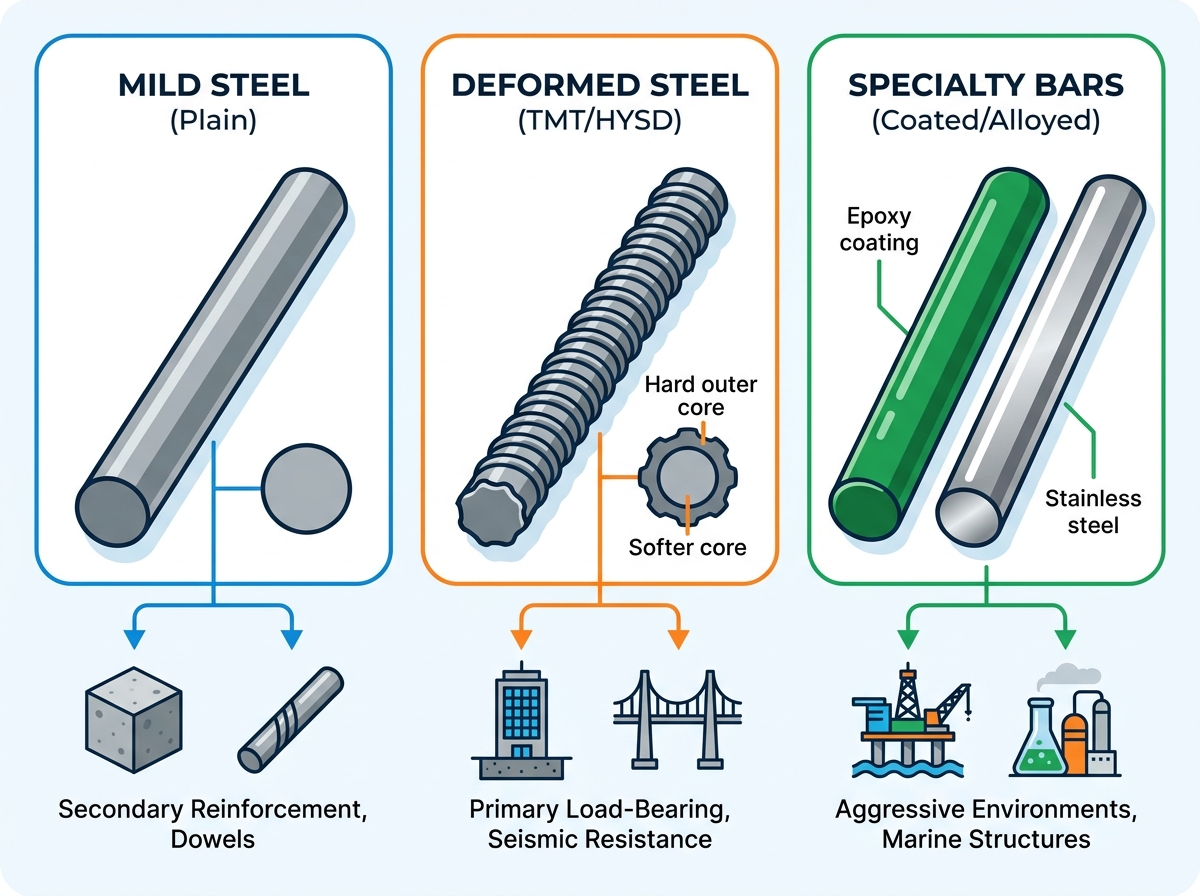
Choosing the correct reinforcement category determines the lifespan of a structure. Different environments demand distinct material properties. You must evaluate these options based on yield strength and concrete bonding capabilities. We categorize these materials into three main groups.
Mild steel bars feature a completely smooth outer surface. Manufacturers produce them using mild carbon steel. They offer remarkable ductility and remain easily bendable during fabrication. However, plain bars possess a critical limitation. They form a relatively poor bond with poured concrete compared to ribbed alternatives. Consequently, engineers rarely use them for primary load-bearing structures.
Best For: Secondary reinforcement, dowels, expansion joints, and concrete roads.
Risk Factor: They lack the surface friction required for high-stress anchoring. Avoid using them in heavy columns or beams.
Common Mistake: Substituting plain bars for deformed bars in residential slabs will cause severe structural cracking over time.
Deformed bars feature distinct ridges or ribs along their surface. These ribs lock securely into the surrounding concrete matrix. This category includes older High-Yield Strength Deformed (HYSD) products and modern Thermo-Mechanically Treated (TMT) variants. Today, TMT bars dominate the global construction market.
The manufacturing process gives TMT bars unique properties. Hot-rolled steel undergoes rapid water quenching. This creates a highly hardened outer martensite layer. Meanwhile, the inner core cools slowly into a soft ferrite-pearlite structure. This dual-phase structure provides incredible tensile strength alongside excellent bendability. They absorb massive energy during earthquakes.
Best For: Primary reinforcement in high-rise buildings, bridges, and critical infrastructure.
Evaluation Lens: Always inspect the material for distinct, uniform ribbing. TMT variants offer superior weldability and better corrosion resistance compared to cold-twisted HYSD options.
Certain geographic locations expose structures to aggressive chemical attacks. Standard carbon steel corrodes rapidly in these environments. Specialty treated bars solve this problem. Manufacturers apply epoxy coatings or zinc galvanization to protect the underlying steel. Some high-end projects use solid stainless steel alloys instead.
Best For: Marine structures, chemical processing plants, and bridges exposed to de-icing salts.
Implementation Reality: Epoxy coatings remain highly prone to physical chipping during transport. Rough handling exposes the raw steel beneath. Stainless steel provides unmatched lifetime durability. However, it significantly increases your initial procurement budget.
You cannot order reinforcement materials blindly. Engineering drawings specify precise material strength requirements. Understanding these specifications ensures regulatory compliance and structural safety.
Grading systems indicate the minimum yield strength of the material. Yield strength represents the maximum stress the material can endure before permanent deformation occurs. Different regions use different naming conventions.
In metric systems, a grade like Fe500 indicates a yield strength of 500 N/mm². The "Fe" stands for Ferrum (iron). In imperial systems, you might see ASTM Grade 60. This indicates a yield strength of 60,000 pounds per square inch (psi). High-seismic zones require materials offering high ductility. You will often see an attached "D" (e.g., Fe500D). The "D" signifies enhanced elongation properties.
Reputable manufacturers produce materials adhering to strict international frameworks. Familiarize yourself with these foundational codes.
ASTM A615: The standard specification for carbon-steel deformed and plain billet-steel.
ASTM A706: This standard covers low-alloy steel. It specifically requires enhanced weldability and restricted chemical composition.
BS 4449: The British Standard for carbon steel bars used for the reinforcement of concrete.
Decision Framework: Always match the standard to your regional building codes. Using standard A615 in a highly active seismic zone violates safety protocols. You must upgrade to A706 or Fe500D equivalents.
Never accept a delivery without reviewing the official Mill Test Certificate. The MTC acts as the structural passport for your material batch. It verifies the exact chemical composition. High carbon levels make the metal brittle. High sulphur or phosphorus levels cause cracking during cold bending. The MTC also confirms mechanical properties like ultimate tensile strength and percentage elongation. Authentic suppliers always provide digitized, batch-specific MTC documents.
Translating structural blueprints into physical orders requires a deep understanding of sizing conventions. Reinforcement materials arrive in standardized diameters and lengths. You must navigate these metrics accurately.
Global markets utilize both metric and imperial measurements. Metric projects utilize standard diameters spanning from 8mm up to 40mm. Imperial regions utilize a numbering system based on eighths of an inch. For example, a #3 bar represents a 3/8-inch diameter. A #8 bar equals a 1-inch diameter. Cross-referencing an accurate steel bar size chart prevents catastrophic ordering errors across international borders.
Engineers distribute structural loads by combining different diameters. Using a single massive diameter often causes concrete cracking. Multiple smaller diameters provide better stress distribution.
Application Guide by Diameter
Metric Diameter | Imperial Equivalent | Primary Structural Application |
|---|---|---|
8mm - 12mm | #3 - #4 | Slab reinforcement, stirrups, ties, and residential footings. |
16mm - 20mm | #5 - #6 | Primary load-bearing columns, heavy beams, and retaining walls. |
25mm - 32mm+ | #8 - #11 | High-rise foundations, bridge piers, and industrial ground slabs. |
Mill production involves acceptable rolling margins. Steel Bars rarely measure precisely to the micro-millimeter. Industry standards allow specific weight and diameter tolerances. Usually, smaller diameters allow a ±7% variance, while larger ones allow ±3%. Undersized deliveries directly compromise structural safety. Conversely, oversized deliveries mean you pay for extra weight. You must weigh sample batches on-site. Compare the actual weight against the nominal theoretical weight.
Accurate procurement requires converting linear drawing measurements into total metric tonnage. Mills and distributors price their products by weight, not by length. Therefore, mastering weight calculations keeps your budget intact.
Civil engineers rely on a universal formula to determine the steel bar weight per meter. You calculate this using $D^2/162$. Here, "D" represents the steel bar diameter in millimeters. The result gives you the nominal weight in kilograms per meter (kg/m). This formula derives from the standard density of steel, which sits at 7850 kg/m³. Knowing this allows quick field checks without relying entirely on supplier manifests.
Memorizing the core formula helps on-site. However, procurement teams operate faster using a formalized reference guide. Accurate steel bar dimensions directly dictate the tonnage per truckload.
Standard Metric Weights Reference
Nominal Diameter (mm) | Weight per Meter (kg/m) | Weight per 12m Length (kg) |
|---|---|---|
8 | 0.395 | 4.74 |
10 | 0.617 | 7.40 |
12 | 0.888 | 10.66 |
16 | 1.580 | 18.96 |
20 | 2.466 | 29.59 |
25 | 3.858 | 46.30 |
Understanding these steel bar sizes and weights proves essential. It translates abstract structural drawings into exact procurement tonnage. You can schedule delivery trucks efficiently based on maximum axel load limits.
Manual calculations invite human error. Modern teams utilize a reliable steel bar weight calculator embedded in procurement software. You simply input the bar diameter, total running length, and bend deductions. The system outputs the exact required tonnage. This automation prevents expensive over-ordering. It also ensures you do not run short mid-pour. Digital tools streamline operations and protect profit margins.
Procurement teams must balance stringent quality requirements against hard budgetary constraints. The cheapest quote rarely represents the safest choice. Understanding supply chain mechanics empowers better commercial decisions.
Commodity markets fluctuate daily. Base prices depend heavily on raw material costs, including iron ore and scrap metal. Energy costs for furnace operations also dictate mill pricing. Furthermore, localized freight constraints impact your delivered cost significantly. Transporting heavy tonnage across long distances consumes fuel rapidly. Premium add-ons also increase costs. High-ductility variants and epoxy coatings usually command a 15% to 30% premium over standard pricing.
Beware of suppliers offering rates drastically below the market average. Unscrupulous vendors employ several dangerous tactics. They might mix lower-grade materials into premium batches. Some supply re-rolled scrap metal. This scrap often contains excessive carbon, making the final product disastrously brittle. Others engage in short-weighting. They falsify bundle weight tags to charge for phantom material. Structural failures frequently trace back to these deceptive procurement practices.
Protect your project by auditing your suppliers rigorously. Implement this standard evaluation framework before signing purchase orders.
Certification Verification: Do they provide ISO-certified MTCs clearly mapped to your specific batch delivery?
Custom Fabrication: Can they accommodate custom cut-to-length orders? Factory cutting minimizes expensive on-site scrap waste.
Logistics Capacity: What are their realistic delivery lead times? Do they own the transport fleet required for heavy, continuous tonnage drops?
Tolerance Policies: Do they guarantee rolling margins strictly within national compliance codes?
Securing a transparent, volume-based agreement with a certified mill eliminates most project variables.
Specifying the right structural reinforcement demands rigorous attention to detail. You must balance mechanical grade requirements, precise dimensional tolerances, and verified material quality. Relying on a standardized weight reference chart prevents massive logistical bottlenecks. Understanding regional pricing structures helps you avoid deceptive vendor traps. You protect your structural integrity while maintaining strict budgetary control.
Never finalize large material orders based solely on baseline pricing. We encourage you to consult directly with structural engineers to finalize exact technical specifications. Contact certified manufacturers or authorized distributors today. Request a fully transparent, volume-based quote backed by authentic mill test certificates.
A: Mild steel features a completely smooth surface and lower yield strength. Engineers primarily use it for minor works or dowels. Deformed bars feature distinct surface ribs. These ribs mechanically lock with poured concrete, providing the high tensile strength required for primary load-bearing elements.
A: You can use the standard industry formula: $D^2/162$. Simply multiply the bar's diameter (in millimeters) by itself, then divide by 162. For example, a 10mm bar is (10x10)/162, which equals approximately 0.617 kg/m. Alternatively, use standardized reference charts.
A: Fe500 or Fe500D TMT grades represent the current global industry standard for residential load-bearing structures. They provide an optimal balance of high tensile strength and seismic ductility. This ensures the foundation and columns can safely support multi-story loads.
A: Not necessarily. Structural engineering relies on the optimal distribution of the steel area. Using multiple smaller-diameter bars often provides better crack control and stronger concrete bonding than using a few oversized bars. Engineers calculate precise layouts for maximum efficiency.


