

close
Choose Your Site
Global
Social Media
Views: 0 Author: Site Editor Publish Time: 2026-08-10 Origin: Site


Selecting the correct structural reinforcement directly dictates project safety and overall budget parameters. Poor sizing decisions often trigger expensive over-engineering. Sometimes they cause disastrous compliance failures during final municipal inspections. Standardizing Steel Bars across a complex site requires intense precision. You must seamlessly align architectural blueprints with actual local supply chain realities. Every millimeter of variance shifts both load capacities and final procurement costs.
This guide serves as a highly practical technical reference. It helps procurement managers and estimators evaluate physical parameters easily. You will calculate weight-based pricing quickly and accurately. We explore how to verify material specifications deeply before authorizing large bulk orders. You will learn to optimize ordering logic, secure standard materials, and prevent costly site delays. Understanding these strict construction parameters ensures your next project stays within required safety codes. It also actively protects your tight budgetary constraints.
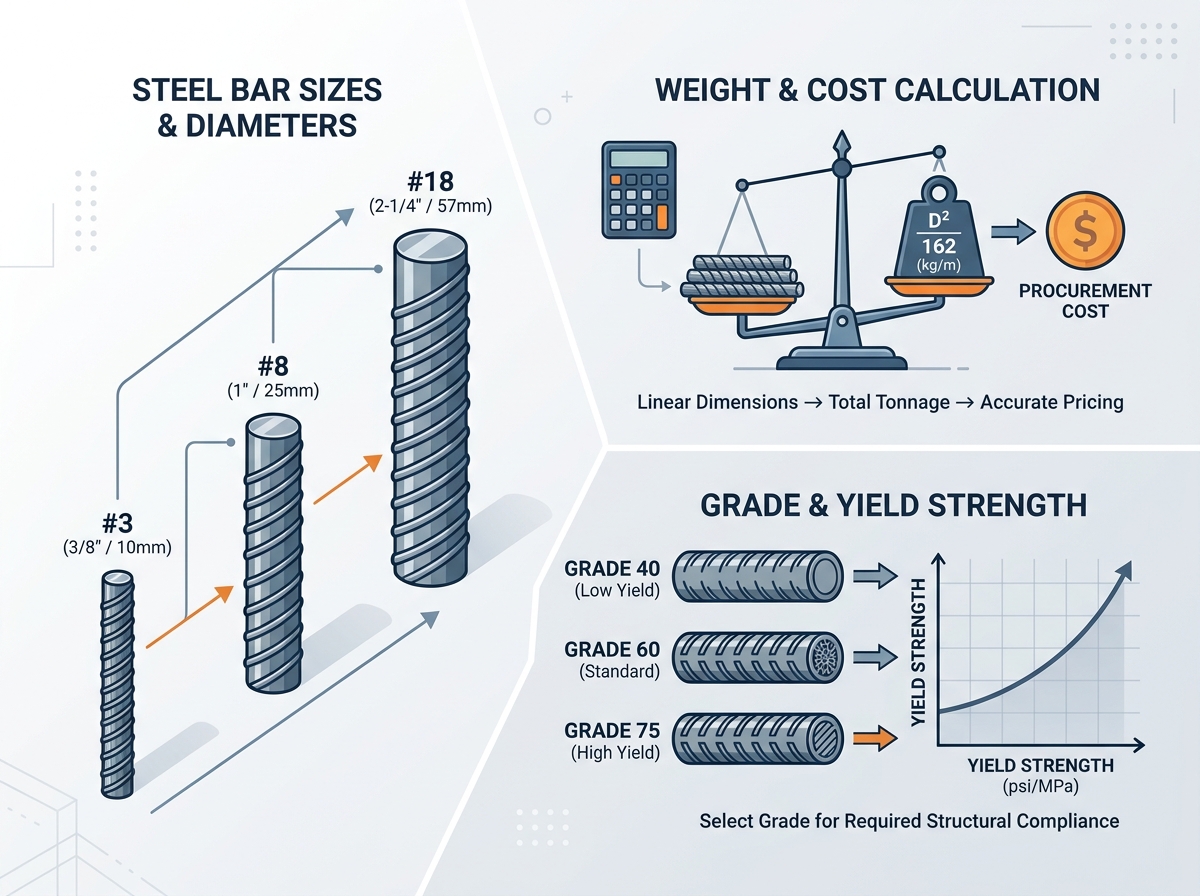
Steel bar sizes range from #3 (3/8 inch) to #18 (2 1/4 inches) in the US, and 6mm to 50mm in metric markets, dictating load-bearing capacity.
Project estimating requires a precise steel bar weight chart to translate linear dimensions into tonnage for accurate pricing.
Choosing the correct steel bar grades (e.g., Grade 40, 60, 75) is just as critical as size, directly affecting yield strength and structural compliance.
Procurement should always require Mill Test Reports (MTRs) to verify actual dimensions and grades against international standards (ASTM/BS).
To establish an accurate procurement baseline, you must master standard sizing frameworks. Engineers rely on verifiable, industry-standard data to specify load-bearing elements. Naming conventions differ significantly across global regions. The US imperial system uses eighths of an inch. A #4 designation translates directly to a 1/2-inch steel bar diameter. Metric markets use exact millimeter designations instead. You will commonly see 12mm or 16mm calls on European blueprints. These differences require careful attention during international drawing conversions. Misreading a metric callout for an imperial size creates massive structural deficits.
Review the technical specifications below. This acts as a foundational reference for accurate material takeoff. Cross-sectional area dictates the ultimate tensile capacity of the concrete member. You cannot estimate load distribution safely without this exact value. We provide this comprehensive steel bar size chart to standardize your internal data.
Bar Designation Number | Nominal Diameter (inches) | Nominal Diameter (mm) | Cross-Sectional Area (sq. inches) |
|---|---|---|---|
#3 | 0.375 (3/8") | 9.525 | 0.11 |
#4 | 0.500 (1/2") | 12.70 | 0.20 |
#5 | 0.625 (5/8") | 15.875 | 0.31 |
#6 | 0.750 (3/4") | 19.05 | 0.44 |
#7 | 0.875 (7/8") | 22.225 | 0.60 |
#8 | 1.000 (1") | 25.40 | 0.79 |
#9 | 1.128 | 28.65 | 1.00 |
#10 | 1.270 | 32.26 | 1.27 |
#11 | 1.410 | 35.81 | 1.56 |
Applying specific steel bar sizes to the correct construction stages prevents expensive material waste. Residential projects typically utilize smaller gauges. You will frequently see #3, #4, and #5 sizes reinforcing driveways, patios, and light commercial flatwork. They handle concrete shrinkage and temperature cracks effectively. Heavy civil infrastructure demands substantial tensile capacity. Teams use #8 and larger profiles for bridge columns, high-rise foundations, and massive retaining walls. Properly matching the physical dimension to the application ensures strict compliance. It also keeps field teams moving efficiently during the rebar tying phase.
Understanding these profiles reduces communication errors between the design office and the field crew. Estimators rely on this framework to build precise bill of materials. You must document these designations explicitly on every purchase order.
Physical dimensions directly influence logistics planning and budget forecasting. Connecting volume requirements to actual mass remains crucial for precise estimating. Material suppliers rarely sell structural reinforcement by linear footage. Instead, they calculate your steel bar price based entirely on total tonnage. Failing to accurately convert linear blueprint measurements into tonnage ruins budgets. Transport trucks have strict legal payload limits. You must plan deliveries based on heavy mass, not just bundle length.
Understanding weight metrics requires reliable conversion logic. Every procurement team needs a dependable matrix to translate drawing lengths into deliverable mass. You should consult a standardized steel bar weight chart during the early bidding stages. Below is a standard steel bar sizes and weights reference matrix.
Bar Size | Weight per Foot (lbs/ft) | Weight per Meter (kg/m) |
|---|---|---|
#3 (10mm) | 0.376 | 0.617 |
#4 (12mm) | 0.668 | 0.888 |
#5 (16mm) | 1.043 | 1.580 |
#6 (20mm) | 1.502 | 2.466 |
#7 (22mm) | 2.044 | 2.980 |
#8 (25mm) | 2.670 | 3.850 |
You can estimate mass instantly using the industry standard formula. For metric systems, square the diameter in millimeters, then divide by 162. This mathematical shortcut yields the exact steel bar weight per meter. A 10mm bar calculation looks like this: 100 / 162 = 0.617 kg/m. For imperial measurements, estimators often use a similar approach by squaring the designation number and dividing by 2.67.
Estimators must also account for lap splices. Bars do not run infinitely. Field workers overlap them to transfer loads. This splicing adds extra linear footage beyond the pure architectural span. You must factor this overlapping waste into your tonnage equations.
For massive commercial bids, manual math creates unacceptable risk. Human error during repetitive calculations leads to material shortages. We strongly advise integrating a digital steel bar weight calculator into your software ecosystem. These tools rapidly multiply complex bill of materials against current spot pricing. This integration guarantees accurate cost forecasting before you commit capital. Precision here minimizes waste and maximizes your profit margins.
Choosing the correct size represents only half the engineering equation. Buyers must also select appropriate metallurgical properties. The right material resists unique environmental stressors. We categorize the primary types of steel bars into three distinct solution profiles.
TMT (Thermo Mechanically Treated) Bars: Manufacturers rapidly quench the hot steel surface while the core remains malleable. This creates a hard martensite outer ring and a soft ferrite-pearlite core. They offer high yield strength and exceptional ductility. They serve as the undisputed standard for active seismic zones because they bend without snapping.
Mild Steel Bars: These feature a smooth, plain surface without aggressive ribbing. They possess a much lower tensile capacity. Contractors primarily use them for secondary structures, pavement doweling, or temporary supports.
Epoxy-Coated and Galvanized Bars: Engineers mandate these protected variants for severe environments. The exterior layers prevent rapid corrosion in marine facilities or high-chloride winter roadways. Rust expansion inside concrete causes catastrophic structural spalling. These coatings prevent that destructive chemical reaction entirely.
Performance directly aligns with metallurgical grading. Structural engineers rely heavily on established material ratings like ASTM A615. A standard Grade 60 designation means the metal yields at exactly 60,000 pounds per square inch (psi). Upgrading to Grade 80 increases load capacity significantly. Choosing these higher steel bar grades allows designers to reduce bar clustering in tight concrete forms. Less congestion means faster concrete pouring and better internal aggregate distribution.
However, over-specifying material grades wastes valuable procurement funds. Purchasing premium Grade 80 material for a basic residential slab offers no tangible structural benefit. It only inflates raw material costs needlessly. Proper alignment between design loads and actual grades protects your budget margin. You must specify exact steel bar dimensions alongside the proper grade. Ensuring these details match prevents job site rejections.
Real-world procurement involves unpredictable hurdles. Building project trust requires acknowledging actual supply chain realities. You cannot treat structural reinforcement as a perfectly uniform, theoretical commodity.
First, consider manufacturing tolerances. Mills cannot produce perfectly identical weights every single shift. Heavy rolling processes inherently introduce slight physical variations. Standards like ASTM strictly define acceptable deviation limits. A bundle might weigh slightly more or less than its theoretical target. Common tolerances allow for up to a 6% weight variance. Estimators must account for these allowable tolerances when finalizing bulk tonnage orders. Ignoring these variances causes unexpected material shortages mid-project.
Regional availability also dictates project timelines significantly. Standard gauges sit readily in most local stockyards. However, massive #14 and #18 sizes frequently demand custom rolling schedules. These specialized heavy materials require extensive lead times. You must communicate early with steel fabricators to secure heavy civil materials. Transport logistics also play a major role. Standard trailers only accommodate 40-foot or 60-foot bar lengths. Designing longer unbroken spans requires expensive specialized transport permits.
Finally, you must rigorously verify your vendors. Counterfeit or substandard materials jeopardize entire infrastructures. Unscrupulous suppliers might misrepresent material origins or grades. Always demand detailed Mill Test Reports (MTRs) before unloading delivery trucks.
Best practices for robust vendor verification include checking:
Heat numbers: Trace the exact steel batch back to the original furnace. This proves manufacturing origins and quality control.
Tensile test results: Confirm the yield strength matches the required grade perfectly.
Chemical composition: Ensure the carbon and alloy levels meet standard weldability specifications, especially if using ASTM A706.
Elongation data: Verify the material possesses enough ductility to survive field bending processes without fracturing.
We often observe several common mistakes during procurement. Teams frequently ignore lap splice overlaps when calculating total linear footage. Buyers sometimes accept delivery bundles bearing unreadable or missing identification tags. Strict traceability prevents catastrophic compliance failures. Thorough vetting guarantees you receive exactly what your engineering team specified. It eliminates dangerous guesswork from your procurement lifecycle.
Successful project execution demands a highly disciplined approach to reinforcement procurement. You must balance accurate sizing against precise weight calculations constantly. Selecting the appropriate metallurgical grade ensures strict code compliance and long-term structural integrity. Guessing on dimensions or tonnage conversions leads directly to costly delays. You risk failing municipal inspections or halting site progress completely.
Take immediate action to refine your bidding process today. Download our comprehensive structural spec sheet to standardize your internal reference materials. You can input your latest blueprints into our proprietary digital tools for instant tonnage yields. Contact our dedicated sales engineering team immediately. We will verify current market pricing and secure regional stock availability for your next major concrete pour.
A: You estimate metric weight using the standard formula D²/162. Multiply the diameter in millimeters by itself, then divide by 162. This gives the precise weight in kilograms per meter. For large commercial projects, professionals rely on comprehensive weight charts or automated calculators to quickly process massive tonnage totals.
A: Residential projects typically utilize #3, #4, and #5 rebar. These sizes correspond to 3/8-inch, 1/2-inch, and 5/8-inch diameters respectively. Contractors rely on these specific gauges because they offer ideal tensile strength for driveways, basement foundations, patios, and standard retaining walls without requiring heavy-duty fabrication equipment.
A: No. More steel is not inherently better. Structural integrity relies on a precise balance between concrete depth, bar spacing, and metallurgical grade. Using an oversized diameter without engineering alignment can actually cause concrete congestion. This prevents proper aggregate flow during pouring, creating dangerous voids and weakening the overall structure.
A: Higher yield strength grades, like Grade 80, carry a premium price per ton compared to standard Grade 60. However, stronger grades can support heavier loads. This often allows structural engineers to specify smaller diameters or wider spacing. Utilizing stronger grades strategically can actually lower your total tonnage and final costs.


